Someone goes in. The water closes over them. You have roughly 90 seconds before unconsciousness, and maybe four minutes before brain death begins. That is the window. Everything else is paperwork.
Ireland has more water exposure in its working environment than most employers want to think about. Fishing, aquaculture, marine construction, port operations, inland waterways maintenance, river survey work. Add the farms with open slurry tanks and drainage channels, the construction sites beside tidal estuaries, the utility crews working flood-affected infrastructure. The number of Irish workers operating near water on any given day runs into the tens of thousands. The number who have received any water-specific first aid training is a fraction of that.
Recent offshore fatalities have forced the conversation. But the skills involved are not exotic. They are specific, they are learnable, and they deteriorate fast without practice. Here is what your team needs to know.
What Drowning Actually Looks Like
Forget the films. Drowning is almost silent. A person in real distress cannot shout. Their body goes into an instinctive drowning response: arms pressing down on the water, head tilted back, mouth at the surface. They cannot wave. They cannot call out. They are using every muscle to keep their airway above water, and they will lose that fight inside 60 seconds.
Secondary drowning adds another layer. A casualty can be pulled from the water, appear fine, walk around, and deteriorate over the next 4 to 24 hours as water in the lungs triggers a pulmonary response. Any person pulled from water who was submerged, even briefly, goes to hospital. No exceptions.
Cold water is a separate problem. At Irish coastal and river temperatures, cold water shock hits in the first 30 seconds of immersion, causing involuntary gasping that can pull water directly into the lungs. Cardiac arrest in cold water is not rare.
Water Rescue: What You Do First
You do not go in. This is not cowardice. An untrained rescuer entering water to help a drowning person is statistically likely to become a second casualty. Drowning people are in a pure survival state and will climb on top of anything, including you.
The sequence is Reach, Throw, Row, Go, and Go is the last resort.
Reach. Get something to them from the bank or vessel. A rope, a pole, a ladder, a belt, a piece of scaffolding tube. Get on your stomach to lower your centre of gravity. Pull them in.
Throw. A lifebuoy, a throw bag, a rope with a loop. Aim to land it just past them so they can grab it as you pull it back. Shout to them to hold on and kick.
Row. Use a boat, a kayak, a rubber dinghy. Get to them without putting your body in the water.
Go. If trained in water rescue, if you have a flotation device, and if there is no other option. You go in with something between you and the casualty, never direct body contact.
Every workplace near water needs throwable rescue equipment within reach of any point where a fall into water is possible. This is not aspirational. It is a legal requirement under the Safety, Health and Welfare at Work Act 2005 and the associated risk assessment obligation. If your risk assessment does not identify water entry as a credible hazard, it is not fit for purpose.
CPR Technique for a Drowning Casualty
Standard CPR applies, with one difference: you start with five rescue breaths before compression. Drowning arrests are hypoxic, meaning the heart stopped because the brain ran out of oxygen, not because of a cardiac event. Getting oxygen in first matters.
The sequence:
- Get them out of the water as fast as safely possible. Do not attempt CPR in the water.
- Check for response. Shout, tap shoulders.
- Open the airway. Head tilt, chin lift. Look, listen, feel for breathing for no more than 10 seconds.
- If not breathing normally, give five initial rescue breaths. Seal your lips around theirs, pinch the nose, and breathe steadily for one second each. Watch for chest rise.
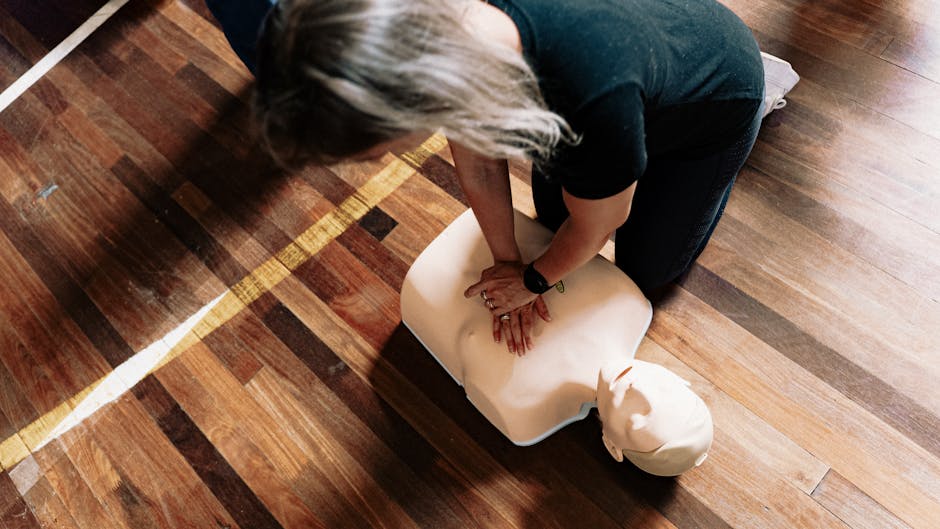
- Begin 30 chest compressions. Hard, fast, centre of the chest. Push down 5 to 6 centimetres. 100 to 120 compressions per minute. Let the chest fully recoil.
- Two rescue breaths. Then 30 compressions. Continue 30:2 until the AED arrives, emergency services take over, or the casualty shows clear signs of life.
Do not stop to remove wet clothing unless it is directly impeding compressions. Do not tilt them to drain water. That is not a thing that works. Keep going.
Water in the stomach will often cause vomiting during CPR. Turn the casualty onto their side briefly, clear the airway with a finger sweep if needed, return to CPR. It is unpleasant. Keep going anyway.
Knowing how to manage a sudden cardiac or trauma event in the field follows similar principles around airway, breathing, and staying committed until the paramedics arrive.
The Recovery Position
If a pulled-from-water casualty is breathing but unconscious, the recovery position keeps their airway open and lets any water or vomit drain.
Kneel beside them. Arm nearest you out at a right angle, palm up. Far hand placed palm-down against their near cheek. Pull the far knee up. Roll them towards you onto their side. Top knee forward to stabilise. Tilt the head back to keep the airway open. Monitor constantly.
Cold, wet casualties lose heat fast. Cover them if possible. Do not rub the limbs. Do not give anything to drink. Do not let them stand up and walk it off.
What Your Workplace Near Water Actually Needs
Training refreshed every two years minimum. Annual is better because CPR technique degrades within months of a single course. Not a video, not a handout. Hands on a mannequin.
A written water emergency procedure, specific to your site, posted where people can read it without a broadband connection.
Rescue equipment inspected monthly. A lifebuoy with a 30-metre line. A throw bag where throwing distance is the constraint. Signage. The equipment nobody checks is the equipment that will not be there.
A clear 999 call script at the point of rescue. Who to call, what to say, what location information the dispatcher needs. Irish coastal waters use the National Maritime Operations Centre. Inland, it is 999 or 112. Your team should not be working that out with shaking hands.
Severe and sudden injuries at work demand the same principle across the board: the first two minutes of a trained response matter more than any emergency service response time.
The Turn
The legal framework is there. The Safe Pass system, the FETAC first aid response training, the General Application Regulations. None of it specifically mandates water rescue skills for waterside workplaces, which is a gap you could park a ferry through. That makes it a risk assessment obligation rather than a prescribed training requirement, and risk assessments only close that gap if somebody asks the hard question: if one of our crew went in right now, what would actually happen?
Ask it. Answer it honestly. Then fix what the answer reveals.