Every year, people die on Irish roads while walking or cycling. Not because the roads are uniquely treacherous. Because the systems built around them treat cars as the default and everyone else as an afterthought.
That is not an opinion. It is the pattern visible in collision data, court records, and the geography of Irish towns built around car access for decades. The Road Safety Authority's own figures show vulnerable road users, meaning pedestrians, cyclists, and motorcyclists, are consistently overrepresented in fatal collision statistics relative to their share of road use. Cyclists account for roughly 5% of road deaths despite making up a small fraction of traffic. Pedestrians regularly account for 15 to 20% of road fatalities in a given year.
The infrastructure and the law both have a role to play. Right now, neither is doing enough.
Minimum Passing Distance: The Rule That Exists on Paper
Ireland does not have a specific statutory minimum passing distance for overtaking cyclists, unlike France (1.5 metres outside built-up areas, 1 metre inside) or Spain. The Road Traffic Act requires drivers to overtake safely and at a safe distance. What that means in practice is left to interpretation, and interpretation at speed on a rural road tends to be generous to the driver.
The RSA has campaigned for a 1 metre minimum in built-up areas and 1.5 metres elsewhere. Road safety organisations have pushed for this to be put into law. It has not happened yet. Until it does, a driver who clips a cyclist with a wing mirror and pleads "I thought I had room" has a defence that is genuinely difficult to challenge.
The consequence of a car passing too close at 80 km/h is not a minor incident. The aerodynamic turbulence alone can destabilise a cyclist. An actual contact at that speed is life-altering.
Visibility: The 60-Second Fix That Still Gets Ignored
Cyclists are required to use front and rear lights between sunset and sunrise. That is the law. What it does not cover is the grey reality of Irish winter afternoons, where visibility drops to near-darkness at 4pm and plenty of cyclists are on the road without lights, high-visibility gear, or any reflective material.
Equally, plenty of drivers are not looking. Distracted driving in Ireland is a genuine and documented problem. A driver checking a phone at 50 km/h travels the length of four car lengths in the second they look down. A cyclist or pedestrian does not need to be invisible to be missed. They just need to be in the wrong place when attention slips.
High-visibility vests cost under a tenner. Decent rechargeable lights cost twenty euro. The argument that visibility gear is too expensive has never held up.
For pedestrians, the issue is different. They cannot reasonably be expected to wear hi-vis to the shops. The obligation shifts to infrastructure: lighting, crossing points, footpath continuity. In rural Ireland in particular, footpaths simply stop. A person walking along a regional road at night has a grass verge and a prayer.
Shared Infrastructure: The Well-Intentioned Problem
Shared cycle and pedestrian paths sound like progress. In practice, a two-metre strip of tarmac shared between fast-moving cyclists and pedestrians with prams, dogs, and mobility aids creates its own conflict. The path relieves pressure from the road but transfers it to a space with no rules and no enforcement.
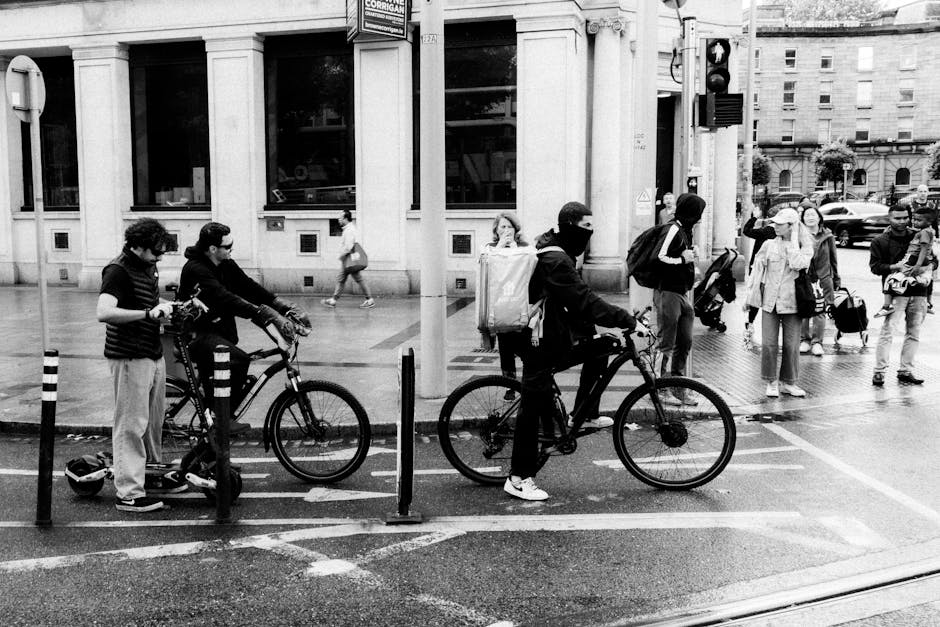
Properly designed cycling infrastructure separates cyclists from pedestrians and from motor traffic. A painted line on a road does not constitute a cycle lane in any meaningful safety sense. It tells drivers where cyclists should be. It does not protect cyclists from drivers who do not notice or do not care.
Dublin has invested in protected lanes in parts of the city centre. Progress is real but slow and uneven. Outside major urban centres, protected infrastructure is almost nonexistent. A cyclist on a rural road in Roscommon or Tipperary is sharing a lane with tractors, HGVs, and cars at full motorway speed, with no separation of any kind.
Who Is Most at Risk
The data is consistent. Older pedestrians are disproportionately killed, particularly those over 65. They cross more slowly, they may have reduced hearing or peripheral vision, and they are physically less able to survive the impact when a collision does happen.
Children are at risk at school pick-up and drop-off times, in residential areas, and on routes to school where footpaths are absent or interrupted.
Cyclists in urban areas face left-turn collisions, dooring from parked cars, and HGV blind spots. The HGV blind spot issue is worth treating seriously: a large goods vehicle turning left can have no visibility of a cyclist positioned alongside it. This kills people. It is not a freak accident. It is a predictable geometry problem.
Rural cyclists face speed and exposure. No infrastructure, no margin, no recovery if something goes wrong. A driver who misjudges a gap, drifts slightly, or reacts slowly has removed every safety buffer.
What Actually Reduces the Numbers
Speed limits work when enforced. A pedestrian struck at 30 km/h has roughly a 10% chance of being killed. At 50 km/h that rises to around 80%. Lower speeds in residential and town centre areas save lives, but the limit is only useful if drivers respect it.
Segregated infrastructure works. The evidence from the Netherlands, Denmark, and increasingly from UK cities is not ambiguous. When cyclists are physically separated from motor traffic, they do not die at the same rate.
Legally mandated passing distances work. Countries with specific minimum distances on the statute books give enforcement something to work with.
Driver education helps at the margins, but culture changes slowly and crashes do not wait for attitudes to shift.
The Turn
None of this is technically difficult. The geometry of a safe road is well understood. The legislation required to mandate passing distances already exists in draft form and in international precedent. What is missing is the political will to prioritise the people most likely to be killed over the people most likely to complain about being slowed down.
Until then, wear the lights. Wear the vest. Assume the driver has not seen you. It should not be your job to compensate for a system that never fully accounted for you, but right now, it is.