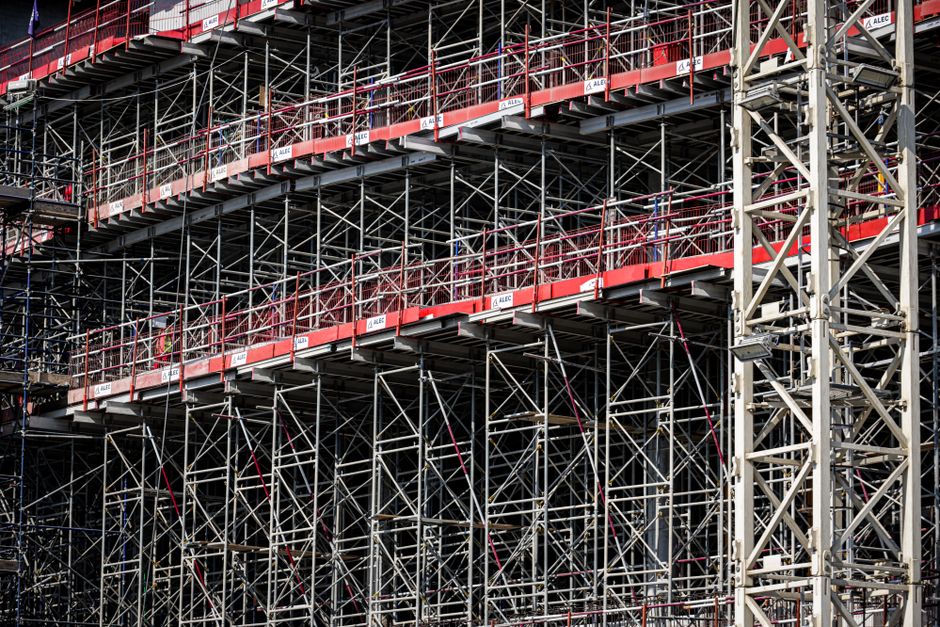
Scaffolding falls keep appearing in fatal incident reports, and the same detail keeps showing up: the worker who fell was new, was being supervised, and had the paperwork to prove they were trained.
That paperwork is doing a lot of work. Too much work.
What the Records Show
Falls from height remain the leading cause of construction fatalities in Ireland. The HSA's own data puts them at the top of the list, year after year. When you dig into the incident profiles, a pattern emerges. It is not exclusively about rogue cowboy operators ignoring the rules. A significant portion of serious and fatal scaffolding incidents involves workers who are, by official records, being brought through proper training channels.
They have cards. They have induction sign-offs. They have a supervisor somewhere on site. And they still fall.
The regulations under the Safety, Health and Welfare at Work (Construction) Regulations 2013 are clear enough about competency requirements for scaffold erection and working at height. The problem is not what the law says. The problem is the gap between what a competency card certifies and what a 19-year-old on week three of a job actually knows in his hands and feet.
The Difference Between Knowing and Doing
A SOLAS scaffolding certification assesses knowledge. Written assessments, practical demonstrations in controlled conditions, supervised tasks on training rigs. All useful. None of them identical to working 8 metres up on a half-built bay scaffold in January wind while someone from below is shouting about the schedule.
Genuine scaffolding competency is physical and situational. It lives in the body. It is reading whether a transom is fully seated before you put weight on it. It is knowing what a slight bounce means underfoot and acting on that knowledge before it becomes an incident. That does not come from a training centre. It comes from accumulated time on scaffold, with someone experienced watching and correcting.
The industry knows this. Experienced scaffolders know the difference between a lad who passed his cert last month and a lad who can work. The problem is that this knowledge does not translate into how supervision is structured or how trainees are deployed.
Where Supervision Actually Fails
The legal requirement is for adequate supervision. What constitutes adequate is where things get murky in practice.
On larger, well-resourced sites, an experienced scaffolder will be within eyeshot for most of a trainee's working hours. On smaller sites, that is often not the case. The experienced hand is on a different section, the trainee is told to get on with it, and the supervision that exists on paper does not exist on the ground.
There is also a subtler failure. Supervisors who came up through the trade sometimes underestimate how much implicit knowledge they carry. They assume a trainee understands things that were never explicitly taught because they seem obvious to anyone who has done it for years. They are not being negligent in any conscious sense. They simply cannot see their own expertise clearly enough to know what the trainee is missing.
This is a known problem in skills transfer research. The psychologist calls it the "curse of knowledge." On a scaffold, it costs lives.
The Competency Assessment Gap
SOLAS scaffolding courses, QQI-aligned programmes, and employer-run inductions all have a role. The issue is that none of them assess competency over time, in real conditions, under real site pressures.
A worker can pass a practical assessment in a training environment and still not be ready for uneven ground, changing weather, non-standard scaffold configurations, or the social pressure of not wanting to be the one who slows the job down. That last one matters more than any checklist. Workers who are new and want to be seen as capable will push on through uncertainty. That is not a character flaw. That is a predictable response to the conditions many sites create.
The scaffold collapses and falling glass that make it into prosecution records are rarely single-cause events. By the time investigators reconstruct what happened, there is usually a cluster of factors. Inadequate supervision sits in almost every cluster involving trainees.
What Needs to Change
The fix is not another course. It is structural.
Time-gated deployment. Trainees should not be working on scaffold above 2 metres without a qualified scaffolder physically present, not on the same section of site, actually present. This should be a site rule written into induction, not an aspiration.
Graduated task assignment. A trainee's first months should involve a deliberately limited range of tasks. Receiving and passing materials. Erecting lower bays under direct supervision. Not being left to work solo on higher sections because the site is under pressure.
Competency reviewed at intervals, not just at certification. The supervisor signs off at week twelve, not just at the induction. That sign-off is not a form-filling exercise. It is a conversation about specific tasks observed in real conditions.
An honest conversation about site culture. The pressure not to flag uncertainty is real on many sites. A trainee who raises a concern about a scaffold configuration should be listened to, not dismissed. Creating conditions where trainees can speak up without social cost is partly a culture question, partly a management one.
The HSA's guidance on working at height sets out the hierarchy clearly. Eliminate the risk, then mitigate it, then protect against it. When a 20-year-old is working at height with a card that was issued eight weeks ago and a supervisor two bays away, none of those steps have been applied to the trainee's actual situation. The risk assessment that covers the scaffold as a structure has not been applied to the gap in that worker's real competency.
The Turn
There is an uncomfortable version of this problem that the industry has not fully confronted. The trainee shortage is real. Sites are under pressure to get people productive quickly. Cards get issued, inductions get signed, and workers get deployed before they are genuinely ready, not because anyone wants to cut corners, but because the system makes it very easy to believe the paperwork represents something it does not.
The experienced scaffolder and the qualified scaffolder are not always the same person. Until competency assessment reflects what actually keeps people alive on site, that gap will keep appearing in fatal incident reports.
A card in a wallet proves someone sat through training. It does not prove they are ready for the job in front of them today.