The first aid kit bolted to the wall of your tractor shed in 2019 does not meet the requirements of Ireland's updated Code of Practice for Preventing Injury and Occupational Ill Health in Agriculture. If you have not looked at it since, that is the problem in one sentence.
Farming kills more workers per year in Ireland than almost any other sector. The HSA's own statistics put agricultural fatalities consistently above construction on a per-worker basis, and that gap has stayed stubbornly wide for years. The updated code, which went through formal HSA consultation, is not a tweak. It is a structural rethink of what emergency preparedness on a working farm actually requires. The first aid section alone has enough new material to make your current setup non-compliant before you finish reading this.
The core issue is scale and isolation. A construction site with twelve workers has a first aider on site, a welfare facility, and emergency services that can reach most sites within fifteen minutes. A farm with one full-time operator and a family member working part-time sits five kilometres from the nearest main road, with mobile coverage that drops out in the silage pit, and a first aid box that contains three plasters and an expired burn gel. The updated code treats those two scenarios as fundamentally different. Finally.
What the Updated Code Actually Changes for First Aid
The revised guidance makes three things explicit that were previously left vague.
First, the code specifies that every farm must complete a written first aid needs assessment. Not a general risk assessment that mentions first aid in passing. A dedicated assessment that maps the specific injury risks on that land, with those people, using that machinery, and determines what supplies and trained personnel are required to respond to the most likely emergencies. Machinery entanglement, crush injuries, falls from height, chemical exposure and tractor rollovers all feature differently depending on the farm type. A tillage operation has a different risk profile to a suckler herd, and the assessment needs to reflect that.
Second, the code introduces clearer thresholds for trained first aider requirements. If you employ even one person other than yourself, and that person is regularly working in conditions where they could be seriously injured and out of earshot, you need a qualified occupational first aider within reasonable response distance. Reasonable is defined in the context of the farm. If your worker is checking fences at the back of a 200-acre holding and collapses, the answer is not "his employer is in the yard." The code wants an actual plan, with an actual trained person, who can get there.
Third, farm employers must now document their first aid arrangements in the Safety Statement. Not reference them. Not attach a course certificate and call it done. Document them fully, review them annually, and update them when anything changes.
What You Need in Your First Aid Kit
The old guidance pointed to a generic workplace first aid kit. The updated code acknowledges that farm injuries are frequently high-severity and that response times to emergency services are long. Your kit needs to reflect both realities.
The minimum for a farm operating with workers should include:
Bleeding control. At minimum two tourniquets suitable for limb application, multiple wound packing gauzes, and haemostatic dressings. Machinery injuries on farms involve significant blood loss at a rate that standard adhesive dressings cannot address. Severe bleeding from a PTO entanglement will not wait for an ambulance that is twenty-five minutes out.
Airway management. Pocket masks for rescue breathing, a bag-valve mask if there is a trained user on site, and airway adjuncts if your first aider is trained to use them.
Immobilisation supplies. SAM splints, triangular bandages, and at minimum one cervical collar. Tractor incidents and falls from farm structures regularly involve spinal trauma. Moving a casualty without stabilisation can convert a survivable injury into something else.
Burns treatment. Burn gel and non-adherent dressings in sufficient quantity for at least a 10% body surface area burn. Chemical burns from slurry, fertiliser and pesticides are an underreported farm injury category.
An AED. The code stops short of mandating one on every farm, but it strongly recommends them for farms employing workers or where older family members are regularly working. Cardiac events are the second most common cause of farm fatality in Ireland after traumatic injury. The window for successful defibrillation is narrow.
All of this needs to be in a container that is weatherproof, accessible, and known to everyone on the farm. "It's in the jeep" is not a first aid plan.
Training Requirements Under the New Code
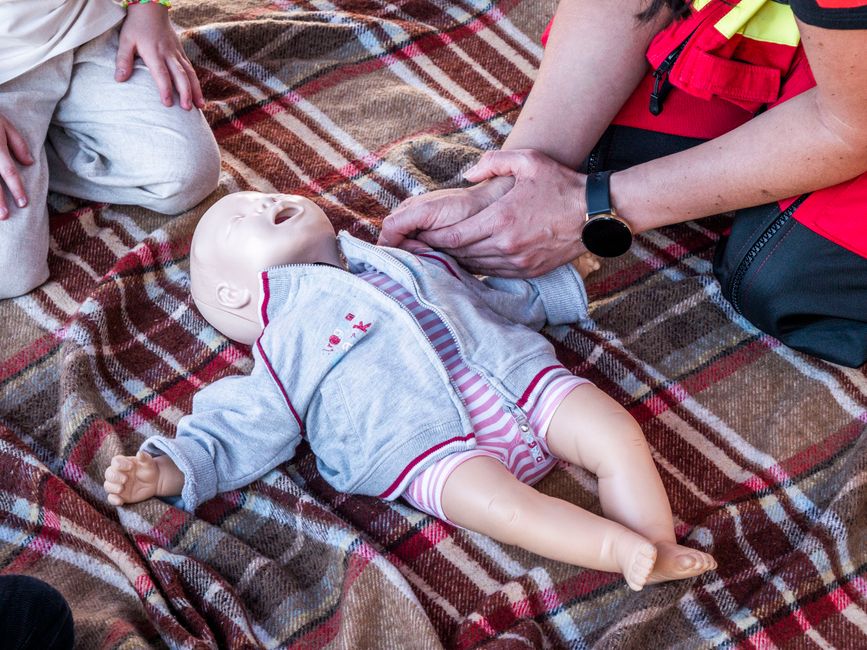
The code distinguishes between two levels of competence. An occupational first aider holds a full QQI-accredited course qualification, renewable every two years. An emergency first aider holds a shorter certification focused on basic life support, bleeding control and calling for help correctly.
For farms with employees, at least one occupational first aider must be designated. For sole operators and family farms, an emergency first aider qualification is the minimum expectation. The HSA has been explicit in its consultation feedback that paper certificates from ten years ago do not meet the renewal requirement.
The training needs to cover farm-specific scenarios, not just the generic course content. Some training providers offer agriculture-specific modules. Use them. Responding to a crush injury under a fallen animal is a different set of decisions than a retail slip-and-fall, and a first aider who has only trained for the latter may freeze at the former.
Reporting After a Farm Incident
The updated code reinforces the existing legal requirement under the Safety, Health and Welfare at Work Act and the associated regulations. Any accident causing more than three consecutive days of absence must be reported to the HSA. Any dangerous occurrence, any fatality, any injury requiring immediate medical treatment must be reported within specific timeframes.
What the code adds is an expectation that farms have a written incident response procedure, not just awareness of reporting rules. That procedure should include:
Who calls the emergency services, and what they say. Who renders immediate first aid. Who secures the scene so it is not disturbed before any investigation. Who makes the mandatory report to the HSA. Who contacts the family if the casualty is a worker.
This sounds like something a multinational would produce for a factory floor. The HSA is saying it should be standard on a family farm in Roscommon. That is the shift.
What the HSA Is Actually Looking For
Farm safety inspections now include a specific check on first aid compliance. Inspectors want to see the written needs assessment, the Safety Statement section on first aid, evidence of current training certification, and a first aid kit that matches the assessed needs. An empty box or a kit full of expired stock is a Prohibition Notice waiting to happen.
The code does not change the underlying law. What it changes is the standard of evidence required to demonstrate compliance. "We have a kit somewhere" does not pass anymore.
Get the assessment done. Update the kit. Renew the training. Write it into your Safety Statement. That is not bureaucracy. That is the difference between a worker surviving a bad morning and not surviving one.