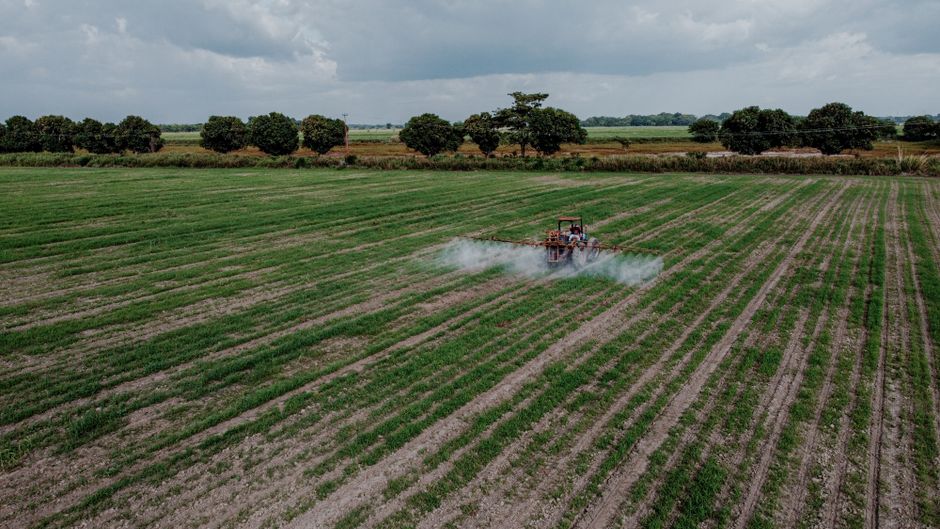
Wildlife is the canary. When EFSA publishes guidance on how pesticides harm insects, birds and soil organisms, occupational health professionals should be reading it too, because the people applying those chemicals are living the same exposure story.
The European Food Safety Authority has spent years refining its frameworks for assessing pesticide risk to non-target species. The language is ecological. The data covers bees, earthworms, aquatic invertebrates. But running underneath all of it is a question that rarely gets asked out loud: if these compounds are toxic enough to disrupt insect endocrine systems and reduce bird reproductive success, what are they doing to the person who mixes the tank, calibrates the nozzle, and walks the headland every day for thirty years?
The Gap Between Environmental Toxicology and Occupational Health
Regulatory systems in Ireland and across the EU assess pesticide risk to humans and risk to wildlife through different channels. The Health and Safety Authority handles worker exposure. The Environmental Protection Agency handles ecological impact. EFSA sits across both but its occupational guidance is narrower than its environmental modelling. The result is that we sometimes know more about what a fungicide does to a hedgehog than to the farmer applying it twice a season for two decades.
This is not a theoretical gap. Organophosphates, neonicotinoids, and certain fungicide groups appear repeatedly in EFSA's wildlife assessments precisely because they affect nervous systems, reproductive biology, and cellular function. These are not mechanisms unique to insects. The same pathways exist in mammals. The same pathways exist in humans.
What Cumulative Exposure Actually Looks Like on the Ground
An agricultural worker on a mixed tillage operation in Carlow or a horticulture crew in Wexford does not encounter one pesticide in one season. They encounter multiple active ingredients, applied across multiple crops, in combination with adjuvants, surfactants, and tank mixes. Some of these workers eat lunch in the cab. Some remove gloves before the job is finished. Some work in conditions where PPE becomes impractical at 24 degrees.
The occupational exposure limits set for individual compounds tell you something useful. What they do not tell you is what happens when a worker accumulates low-level exposure to six different active ingredients across a season, year after year. EFSA's wildlife guidance addresses exactly this cumulative and mixture-toxicity question for ecological risk assessment. Occupational health monitoring for agricultural workers in Ireland rarely does.
What Employers Are Actually Required to Do
Under the Safety, Health and Welfare at Work (Chemical Agents) Regulations, employers must assess the risk from every hazardous substance used at work, provide appropriate controls, and arrange health surveillance where the risk warrants it. For workers involved in pesticide exposure, this means more than handing out nitrile gloves and a product data sheet.
Health surveillance for agricultural workers exposed to pesticides should include baseline biological monitoring where relevant, particularly for organophosphate exposure where cholinesterase activity is a meaningful indicator. It should include periodic review as the product mix on the holding changes. It should include records that follow the worker across seasons and employers, which almost never happens.
The practical failure is not usually deliberate. It is structural. A contractor with four seasonal workers applying herbicide to a client's potato crop does not automatically think of himself as running a health surveillance programme. The regs say he should.
Reading the Wildlife Science as an Occupational Signal
EFSA's updated guidance frameworks on cumulative exposure in wildlife assessments are methodologically useful for occupational health professionals willing to look sideways at the data. The models identify which compound groups create the highest cumulative burden in sentinel species. Those are the same compound groups worth prioritising in worker biological monitoring programmes.
Pyrethroid neurotoxicity in aquatic invertebrates maps onto known human neurological effects at higher concentrations. Azole fungicide reproductive effects in birds reflect mechanisms relevant to endocrine disruption in mammals. This is not cherry-picking. It is using the most rigorous available toxicological modelling to inform a monitoring gap.
The wildlife data also flags timing and seasonality in ways that occupational risk assessments often miss. Peak exposure windows for farmland birds correlate with spraying seasons. Peak occupational exposure for workers correlates with the same periods. If your crew is doing intensive application work in April and May, that is when your health monitoring attention should be sharpest.
Building a Monitoring Programme That Accounts for This
Employers with outdoor teams regularly working with pesticides need to move beyond the standard annual occupational health screen. A meaningful programme includes several things.
Detailed exposure mapping. Which active ingredients, at what frequency, by which route of exposure. Dermal exposure from mixing and loading operations is consistently underestimated relative to inhalation risk and needs specific attention.
Biological monitoring where validated tests exist. Cholinesterase testing for organophosphate-exposed workers is established. For other compound classes, urinary metabolite panels are increasingly available through occupational health laboratories.
Seasonal review rather than annual review. A single annual screen misses acute effects from high-exposure spraying periods. A screen in June and again in October reflects the actual pattern of risk.
Cumulative records that survive job changes. If a worker moves between three farm contractors in five years, their exposure history should follow them. This requires a recording culture that Irish agricultural employers do not yet have. The farm risk assessment framework is the place to embed this, not a separate document that nobody updates.
The Conversation EFSA Has Started
EFSA did not write its wildlife guidance to reform occupational health monitoring. That was not the brief. But the methodological rigour applied to ecological cumulative risk assessment sets a standard that occupational health for agricultural workers has not yet matched.
Employers who wait for a specific regulatory requirement to trigger action will find themselves several years behind a harm curve that the toxicology already describes clearly. The science on what these compounds do to biological systems is not ambiguous. The only open question is whether worker health monitoring will catch up before the exposure history becomes a diagnosis.
Your outdoor crew is not a sentinel species. Treat them accordingly.