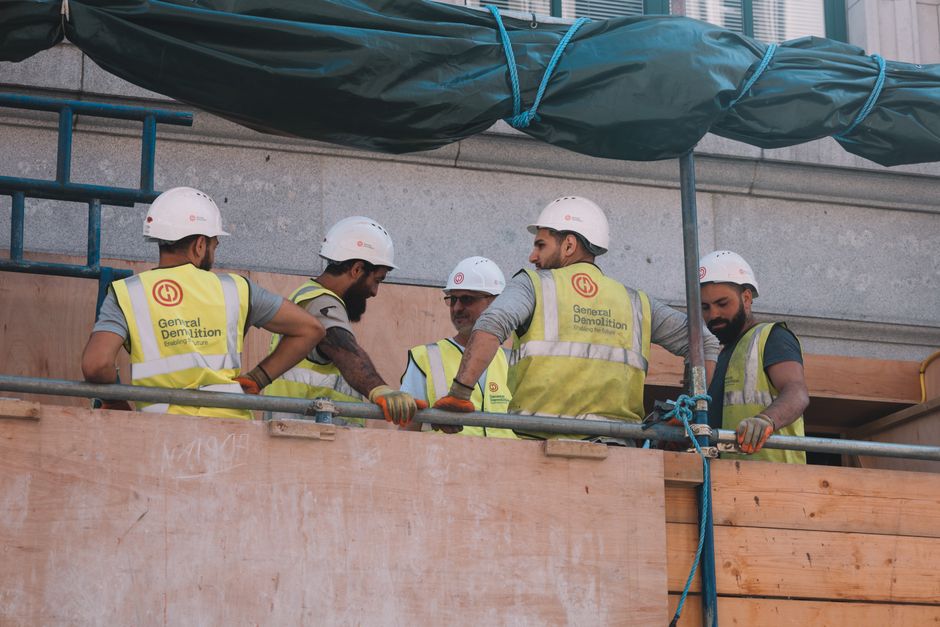
The majority of construction deaths in Ireland don't happen on major infrastructure projects with full safety teams and resident engineers. They happen on small domestic and commercial sites, where a handful of workers are cracking on without anyone whose actual job is to stop them getting killed.
The Health and Safety Authority's own data consistently shows that micro-sites, those with fewer than five workers, account for a disproportionate share of construction fatalities. The pattern is not random. Small sites have thinner margins, shorter project timelines, and a culture where the boss is also the carpenter, the estimator, and the de facto safety officer. That combination is predictable and lethal.
The problem is not that small contractors are reckless. Most of them care deeply about their workers, who are often family members, neighbours, or people they've worked beside for a decade. The problem is that safety systems designed for large sites don't scale down. So small teams end up with no system at all, just good intentions and muscle memory.
Why Small Sites Are Disproportionately Deadly
Bigger sites have dedicated roles. There's a project supervisor, a safety officer, a banksman when the telehandler is moving. On a four-person site, the person who should be doing that job is on the scaffold doing something else.
Supervision gaps are the main driver. When one person is responsible for both executing the work and overseeing it, one of those things gets dropped. It's always the oversight.
Small sites also suffer from familiarity blindness. Experienced tradespeople stop seeing hazards they've worked around for years. The frayed rope, the unsecured trench, the scaffold board with a split running through it. None of these feel urgent because nothing bad has happened yet. That logic holds right up until the morning it doesn't.
The Legal Reality Nobody Tells Small Contractors
The Safety, Health and Welfare at Work (Construction) Regulations 2013 apply regardless of site size. A two-man groundworks crew has the same obligation to identify and manage hazards as a contractor employing 200 people. The HSA doesn't grade enforcement by headcount.
What changes on small sites is the cost of getting it wrong. A larger company absorbs a fine. A small operator does not. A prosecution following a serious injury or fatality can end a business entirely, and that's before the civil liability cases from the injured worker or their family arrive.
The fine is not the worst outcome. The worst outcome is working the rest of your life knowing someone died on your watch because you skipped a step that cost nothing.
What a Functional Small-Site Safety System Actually Looks Like
It does not require a full-time safety manager. It requires three things done consistently.
A proper risk assessment before work starts. Not a template downloaded from the internet and signed without reading. A one-page document written for this specific job, identifying the three or four things that could kill someone on this site. Heights, excavations, overhead lines, plant movements. Name them, write down what you're doing about each one, and make sure every worker on the team has read it.
A daily start-of-shift check. Five minutes. Walk the site. Confirm the edge protection is still in place, the excavation hasn't slumped overnight, the access ladder is secured. Write it down. A dated logbook entry takes ninety seconds and demonstrates due diligence if you're ever inspected or investigated.
A clear voice for stopping work. Every person on site needs to know they have the right to stop if something looks wrong. On small teams, this often doesn't happen because nobody wants to be the one questioning the boss. Build that culture deliberately. The first time someone raises a concern, take it seriously, even if it turns out to be nothing.
The Specific Hazards Killing Small Teams
Falls from height remain the leading cause of construction fatalities in Ireland. Falls from roofs, scaffolding, and leading edges account for more deaths than any other single cause, and small sites are where this happens most because edge protection is treated as optional on short jobs.
It is not optional. A leading edge without protection is a criminal liability, regardless of how quickly you plan to finish the job.
Struck-by incidents involving plant are the second major cluster. A reversing dumper on a tight domestic site, no banksman, nobody watching. That sequence kills people every year. On a four-person team, designating one person as the plant-movement watcher for any reversing manoeuvre is a free intervention that saves lives.
Trench collapse is the third. Groundworkers know the risk but often don't shore trenches under 1.2 metres because they never had a problem before. A cubic metre of saturated Irish soil weighs over a tonne. It gives no warning.
Practical Overhead That Won't Break a Small Operation
A basic site safety file does not require a consultant. The HSA provides downloadable guidance specifically for small projects. A method statement for the two or three highest-risk tasks, written plainly and kept in the site van, satisfies a significant portion of what an inspector wants to see.
Safe Pass and CSCS cards are not optional extras for small sites. Every worker needs a valid card. Checking them takes one minute and protects you legally if the HSA shows up. Insurers have voided policies following incidents where unqualified workers were on site. That is not a theoretical risk.
Tool and equipment inspection costs nothing. A broken disc on an angle grinder, a damaged harness, a scaffold clip that won't close. These fail silently. Assign one person the job of checking equipment at the start of each week. Make it a named responsibility, not a general expectation.
The Turn
Small sites will always be higher-risk environments than large ones. That is structural and won't change. What can change is the basic competency of the people running them. Most fatal incidents on micro-sites don't involve exotic hazards or complex failures. They involve a standard risk that was known, tolerated, and eventually collected its debt.
The four-person team that builds in thirty minutes of genuine safety process per day is not the one that makes the HSA's fatality report. Be that team.