Autumn rolls in, the visibility drops to 30 metres on the N7, and half the cars on the road are running on sidelights. The other half have rear fog lights blazing in clear conditions two days later. Neither group is doing it right.
Fog is Ireland's most predictable seasonal hazard. River valleys, low-lying farmland, coastal roads after a warm day. You know it's coming. What most drivers get wrong is not the big dramatic stuff. It is the small decisions made in the first ten seconds of entering a fog patch: lights, speed, and the gap in front. Get those three things wrong together and you have turned a survivable situation into a collision.
When to Switch Fog Lights On
The legal trigger in Ireland under the Road Traffic (Lighting of Vehicles) Regulations is straightforward. Rear fog lights are required when visibility falls below 100 metres. Not when it feels foggy. Not when there is mist on the windscreen. When you cannot clearly see for 100 metres ahead.
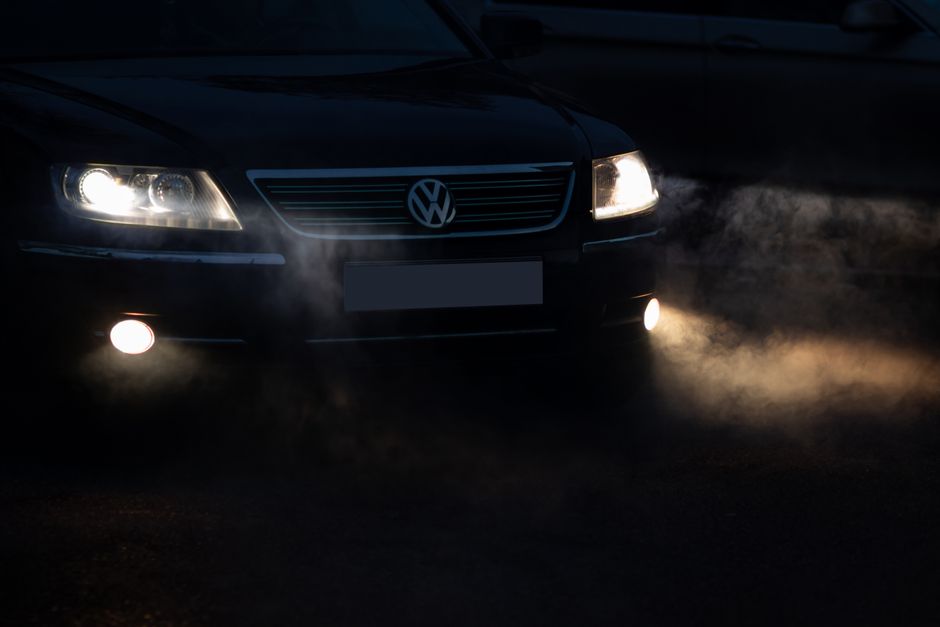
Front fog lights follow the same threshold, but they do less than drivers think. Modern front fog lights add marginal visibility at low speed. What they do not do is compensate for headlights set to sidelights only. In fog, full dipped headlights go on first. Always. Fog lights come after, not instead.
The mistake that causes rear-end collisions is failing to switch the rear fog light off when the fog clears. The light is 21 watts pointing directly at the car behind. In clear air, it blinds following drivers and masks your brake lights. Switch it on when visibility drops. Switch it off when it clears. That is the entire protocol.
Do not use hazard lights while moving in fog. This is a common instinct and it is wrong. Hazard lights flash, making it impossible for following drivers to read your braking intention. They are for stationary emergencies, not moving vehicles in low visibility.
The Gap You Need
The two-second rule is for dry daylight conditions on a good surface. In fog, that rule is not enough.
At 80 km/h in fog you are covering 22 metres per second. If visibility is 50 metres, you have roughly 2.3 seconds to perceive a hazard, react, and brake before you reach the point where you first saw it. That assumes the hazard is stationary. If it is a car braking, that window collapses further.
The rule in fog is simple. You need to be able to stop within the distance you can see. If you cannot see 50 metres, you need to be travelling slowly enough to stop in less than 50 metres. At motorway speeds, that is not physically possible. Slow down until the maths works.
Keep a minimum four-second gap in dense fog on a main road. On rural roads or anywhere you cannot rule out a slow-moving vehicle or a stopped car ahead, increase that further. The driver in front may have reacted to something you cannot see yet.
Junctions in Fog
This is where the serious incidents happen. Road users and distracted driving judgement errors combine at junctions in a way that kills people.
At any junction in fog, your speed on approach must allow you to stop before the give way line even if you cannot yet see what is coming. That sounds obvious. It is routinely ignored. The instinct is to creep forward to see better. The problem is that "creeping forward" puts you into the path of traffic that cannot see you either.
Stop fully at junctions. Wind the window down. Listen. Look both ways twice, slowly. Pull out only when you have confirmed the road is clear in both directions for the distance you need to complete your manoeuvre. At 80 km/h, a vehicle closes 22 metres every second. If visibility is 60 metres, that car is on top of you in under three seconds after you first see it.
At night in fog, do not be seduced by the absence of headlights. Cyclists, motorcycles, and vehicles with failed lighting exist. The absence of lights is not the same as the absence of traffic.
Motorways and Dual Carriageways
Fog on motorways creates the multi-vehicle pileup scenario. The physics are simple. High speed, poor visibility, and a driver who brakes sharply. The car behind them was too close.
On a motorway in dense fog, if you genuinely cannot see 100 metres ahead, you have no business travelling above 60 km/h. Legally, there is no speed floor on a motorway in Ireland, only the 120 km/h ceiling. Morally and practically, the floor is whatever speed lets you stop in the distance you can see. Distracted driving in Ireland is cited constantly in collision analysis, but in fog the more common factor is simply speed that outstripped visibility.
If fog becomes genuinely impenetrable and you need to stop, get fully off the motorway at the next exit. If that is not possible, pull fully onto the hard shoulder, switch off your rear fog light, leave dipped headlights on, switch on hazard lights, and get out of the car and behind the barrier. A stationary car on a hard shoulder in dense fog is a target.
When to Pull In
There is a decision that drivers resist making because it feels like giving up. It is not.
If visibility has dropped below 20 metres, if you are uncertain where the road edges are, or if you are driving a route unfamiliar to you, pull in. A service station, a wide lay-by, a gateway with full clearance off the carriageway. Park with sidelights on, not headlights, so you are visible without creating a false impression of a moving vehicle to another driver navigating blind.
Wait. Fog patches in Ireland rarely last more than 20 or 30 minutes in the same location. That is a small price compared to the alternative.
The drivers who do not pull in are almost always the ones who feel they know the road. Familiarity is not the same as safety.
Know the thresholds. Use the lights correctly. Leave a gap that matches your actual stopping distance. At junctions, treat every approach as if there is a vehicle 60 metres away that cannot see you. And when the fog is thick enough that you are guessing, stop guessing and pull in.