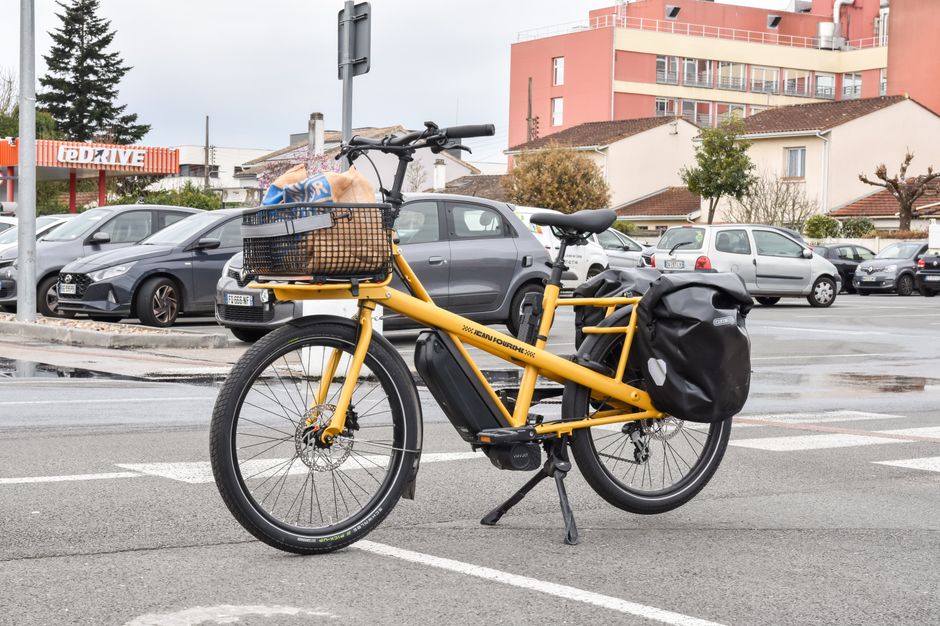
A loaded front basket changes how a bike handles. Most cyclists carrying their weekly shop on two wheels have no idea how much.
Cycling UK's recent webinar on shopping by bike covered a lot of useful ground: cargo bike options, locking strategies, panniers versus baskets. What it surfaced, almost by accident, was a gap that the cycling safety world rarely addresses directly. Parents and commuters are being encouraged onto bikes in growing numbers, but almost nobody is telling them what a bag of shopping does to their stopping distance, their steering response, or where they need to position themselves on a busy road to stay alive.
That gap is where collisions happen.
What Load Does to a Bike
A standard front basket loaded with 5kg of groceries shifts the bike's centre of gravity forward and upward. The front wheel carries more weight, which slows steering response. At low speeds, the bike wants to flop. At higher speeds, it becomes harder to steer quickly out of trouble. Neither is catastrophic on a quiet cycle path. Both are problems on a road shared with lorries and buses.
Braking distance increases significantly with load. A front load also creates a pendulum effect on corners: the weight swings into the turn and pushes the front wheel toward understeer. Riders who have never experienced this, and most haven't, instinctively overcorrect. That overcorrection, on a wet road or a sharp junction, puts them into the path of traffic.
Front-loaded bikes are the most common setup for family and shopping cycling. They are also the least predictable to ride for anyone who hasn't been told what to expect.
The Road Positioning Problem
Cyclist and pedestrian safety on Irish roads guidance generally focuses on where cyclists should be in the lane, how to signal, and how to handle junctions. That guidance assumes a bike that responds normally. It does not account for a rider on a front-heavy bike who needs more space to correct a wobble, more time to brake, and more warning before a turn.
The standard advice to take the primary position in a lane, riding about a metre from the kerb, is correct. But a loaded cargo bike needs that space even more urgently than an unloaded one. The instinct under pressure is to move left, toward the gutter, to get out of the way of overtaking traffic. On a loaded bike, that instinct is more dangerous. The surface near the kerb is worse. The drainage channels, loose gravel, and road debris that sit at the edge of an Irish road are trivial on an unloaded bike and genuinely hazardous on one carrying weight.
Nobody in most family cycling conversations tells parents this. The focus is helmets, high-visibility vests, and lights. Those matter. Load management matters too.
What Parents Are Actually Doing
The family cycling market in Ireland has grown sharply. Cargo bikes, Dutch-style city bikes with rear racks, and bikes fitted with child seats and front baskets are increasingly common on school runs and Saturday market trips. Parents are loading these bikes with children, school bags, shopping, and increasingly, a child seat as well. A child in a front-mounted seat adds 15 to 20kg to the front axle.
Most of these riders have never had a single conversation about how to manage that weight. They have not been told to slow down before a junction rather than during it. They have not been told that their braking distance has roughly doubled. They have not been told to stay well clear of the door zone on a loaded bike, because swerving away from a suddenly opened car door takes longer and requires more road width than it did before.
The result is a population of well-intentioned cyclists, doing the right thing environmentally and actively, operating on roads with a bike that does not behave the way they think it does.
What Actually Helps
Weight distribution is the starting point. If you are using panniers or a rear rack rather than a front basket, the handling difference is significant. Rear loading keeps the front wheel light and responsive. It makes the bike easier to steer quickly and keeps braking behaviour closer to what you expect from an unloaded bike. For riders who have a choice, the rear rack is the safer option by a margin that matters in an emergency.
If a front basket is the setup, keep the load as low as possible inside it. A heavy bottle of wine sitting high in a wire basket is a different problem from the same bottle sitting flat in a deep pannier. Distribute weight evenly across both sides where possible.
Tyre pressure matters more on a loaded bike. Under-inflated tyres on a loaded front wheel increase rolling resistance, slow steering, and make the bike feel sluggish. Check pressure before you ride, not when you get a puncture.
Brake early. The margin of error on a loaded bike is smaller. Braking distance at 20km/h with a 6kg front load is noticeably longer than the same speed without it. Build that into your approach to junctions and zebra crossings.
Practice before you put children or substantial loads on. Ride the bike loaded, in a quiet area, before you take it onto a main road. Feel how it steers. Feel how it brakes. Know what the thing does before you need it to do something quickly.
The Conversation That Isn't Happening
Cycling UK's webinar was aimed at encouraging more people to shop by bike. That is a good goal. The problem is that encouraging uptake without equally encouraging load awareness creates a new cohort of riders who are confident on a bike and underprepared for what their bike is now doing under load.
The cycling safety conversation in Ireland, like in most countries, concentrates on infrastructure and driver behaviour. Both matter enormously. But the rider's own vehicle behaviour under load is a safety variable that sits entirely within the cyclist's control, and it is almost entirely absent from the public guidance.
Know your load. Know your bike. Know your stopping distance. That is where family cycling safety actually starts.