The Ploughing Championship draws 300,000 people to a field in Laois to look at machinery. Then everyone goes home, back to the same yards and sheds where the actual accidents happen, and the conversation stops.
Farm machinery safety in Ireland is not a September problem. It is a year-round one, and the two areas that keep producing injuries and deaths are bale storage and machinery entanglement. Neither requires expensive solutions. Both require consistency.
Why Bale Stacks Kill
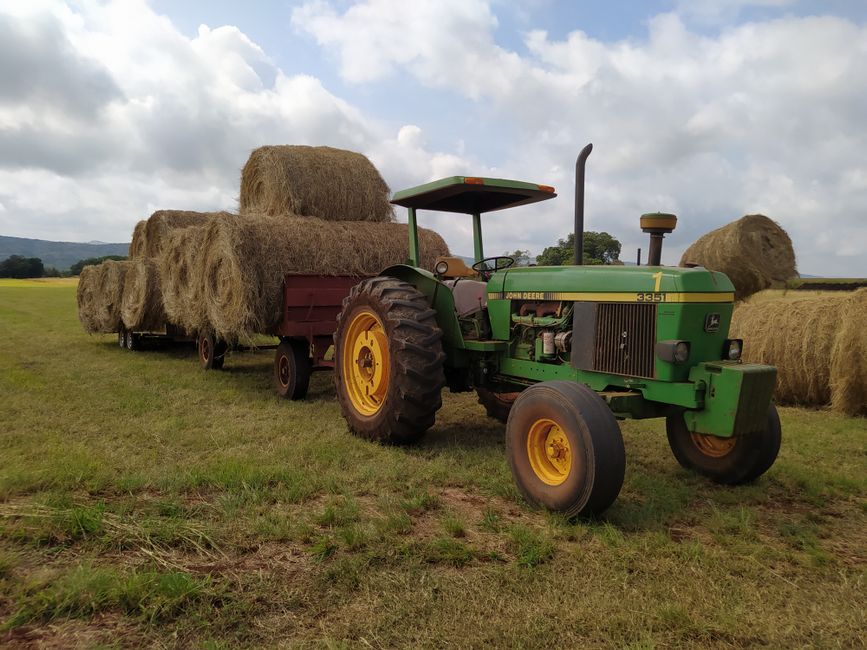
A round bale of silage weighs between 700 and 900 kg. A square bale of hay can go over 500 kg. Neither of these is a gentle object when it moves unexpectedly.
Bale stacks collapse for predictable reasons. The base layer is uneven. The stack goes too high. Bales are stacked on a slope without any kind of restraint. Someone parks a telehandler or quad too close and clips the base. A dog or a child gets into the shed unsupervised. The stack does not care which of these triggers it. The outcome is the same.
The HSA's guidance on bale storage is clear on the fundamentals. Stack on flat, firm, dry ground. Keep stacks to a maximum of three round bales high when stored outdoors and four high indoors with adequate headroom. Ensure the base layer is stable before building upward. Round bales stored on their flat ends are more stable than bales on their curved sides. That one matters more than most farmers realise.
Pyramid stacking is not optional decoration. A stack of 10 bales should taper as it rises. Vertical columns of bales with nothing holding them in place are an incident waiting for a weather event or a bump from equipment to trigger it.
Keep children and visitors away from bale storage areas. Put a physical barrier up if the yard is used by people who are not workers. A length of stock fencing costs almost nothing compared to what follows if a stack comes down on someone.
Machinery Entanglement: The Mechanism Nobody Wants to Think About
Entanglement injuries happen in a fraction of a second. A loose sleeve, a length of baling twine, a scarf, a drawstring. They catch on a rotating shaft and the person is pulled in before they can react. The physics are unambiguous and the results are catastrophic.
The power take-off shaft, the PTO, is the central hazard here. It connects a tractor to an implement and rotates at 540 or 1,000 rpm. At 540 rpm, the shaft completes nine full rotations per second. Any contact with that shaft, or with an unguarded coupling, ends badly.
Machinery entanglement first aid response is a separate skill set. But the goal is to never need it.
The legal position in Ireland is straightforward. The Safety, Health and Welfare at Work (General Application) Regulations 2007 require that all dangerous parts of machinery be guarded. A missing PTO guard is not a minor maintenance issue. It is a legal breach, and the HSA treats it as one during inspections.
A Practical Guarding Checklist for Daily Operations
Walk the yard before the busy season and check these things.
PTO shafts: Every shaft operating between a tractor and an implement needs a full guard covering the rotating component and the coupling points at both ends. Inspect the guard for cracks, missing retaining chains, and wear. A cracked plastic PTO guard is not a functional guard. Replace it before it fails.
PTO stub on the tractor: When no implement is attached, fit the PTO stub cap. Every tractor should have one. Many do not, because it got lost and nobody replaced it. Order a replacement. It costs less than €20.
Augers, balers, feeders, and spreaders: Any implement with rotating parts needs guarding on all sides accessible during normal operation. Check interlocks are working. An interlock that has been tied or wedged open because it was inconvenient is a removed safeguard, which is both a hazard and a prosecutable offence.
Clothing: Overalls should be fitted, not baggy. No drawstrings near rotating parts. No scarves. This is particularly relevant when contractors or seasonal workers come onto the farm. Brief them before they start work, not after something happens.
Bale Handling Equipment: The Overlooked Half of the Problem
Telehandlers and front loaders handling bales create a second category of risk beyond the stack itself.
Never allow anyone to stand near a suspended load. A bale on a spike or in a grab is a suspended load. If it drops or the machine tips, anyone in the vicinity is at serious risk. Keep bystanders at least two full machine-lengths away during bale movement.
Check bale spikes and forks before every season for bends, cracks, and loose welds. A spike that fails under load does not give a warning. Ensure the implement is rated for the weight being handled. Most forks on compact tractors are not designed for the largest silage bales.
The telehandler itself needs attention. Tyres, brakes, seatbelt, ROPS structure. If your telehandler has a known defect, tag it out and fix it before it goes back to work. The pattern behind farm fatalities in Ireland includes a recurring thread of equipment defects that were known and left unaddressed.
Making It Fit the Actual Workflow
Safety advice that requires a full shutdown of operations to implement gets ignored. This does not need to be that.
Build guard checks into the pre-work check for any PTO implement. Three minutes before hitching. If the guard is missing or broken, the implement stays in the yard until it is fixed. That is the rule, and it applies to whoever is operating that day, family member or hired hand.
For bale storage, designate a specific storage area during the summer. Level it, mark it, keep it clear of traffic routes. Stack as you go, correctly from the start, rather than restacking at the end of a long day when attention is low and urgency is high.
Brief seasonal workers the morning they arrive. Not an hour in, not the following week. Before they touch anything. Ten minutes covering what moves, what kills, and where not to stand is a reasonable investment.
The Ploughing is a conversation starter. The yard is where it has to finish.