A worker is struck by a falling load. Another is pinned between a forklift mast and racking. Both incidents happened in the previous six months. Both were entirely predictable.
Forklifts are the most dangerous piece of plant on most construction and industrial sites, and they are also the most normalised. Operators drive them every day. Managers walk past them every hour. The danger becomes wallpaper. Then someone gets hurt, and suddenly everyone is very interested in what the risk assessment said.
The answer, usually, is that the risk assessment said exactly what was needed to pass an audit. It described the hazard. It named a control measure. It got signed. What it did not do was change anything on the ground, because the ground is where shortcuts live.
The Blind Spot Problem Is Geometric, Not Attitudinal
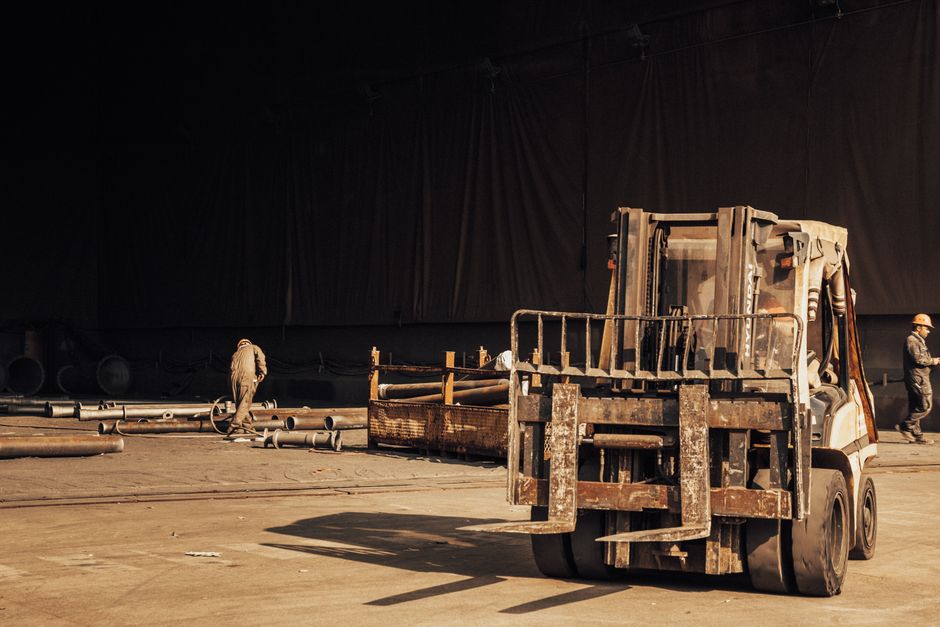
A counterbalance forklift carrying a full load at height can block up to 80 percent of a driver's forward sightline. That is not a training failure. That is physics. The mast, the forks, the load itself all combine to create a wall of steel and material directly in front of the operator. Standard guidance says to travel in reverse when the load obstructs vision. On a busy site, with pressure to move fast and pedestrians everywhere, operators do not always do that. Not because they are reckless, but because the system allows it.
The pedestrian segregation that should make this a non-issue is often inadequate. Painted lines on a warehouse floor are not segregation. A cone at the entrance to a bay is not segregation. Segregation means physical barriers that a pedestrian cannot accidentally cross and a forklift cannot accidentally breach. Anything short of that is a management decision that transfers risk onto the person on foot.
Reversing deaths on Irish sites have already forced changes to backup camera standards, yet the same spatial logic that makes reversing vehicles lethal applies to forward-moving forklifts carrying tall or wide loads. The geometry does not care which direction the machine is travelling.
Falling Loads Are Not Accidents
A load falls from a forklift for one of a small number of reasons. It was not wrapped or secured. The forks were not positioned correctly under the pallet. The pallet itself was damaged. The load was too high for the speed of travel. The operator braked or turned sharply. Every one of those causes has a known control. Every one of them shows up in incident reports as if it were a surprise.
Load containment is not complicated. Pallet integrity checks before lifting. Load weight within the rated capacity for that truck at that mast extension. Stretch wrap or banding where loads are not self-stable. Travel height kept as low as safely possible. These are not innovations. They are in the General Application Regulations. They are in every forklift operator training manual. They are also routinely skipped on sites where throughput is the priority.
The HSA has prosecuted companies for exactly these failures, with fines well into six figures. Machinery safety failures are costing companies millions and workers their limbs, and falling loads sit squarely in that pattern. A 500kg pallet dropped from two metres of height does not give anyone time to step out of the way.
What Plant Safety Procedures Actually Need to Cover
Most forklift safety procedures cover the obvious: pre-use checks, operator certification, speed limits. Fewer cover the specific scenarios where incidents actually happen.
Pedestrian interaction zones. Where do pedestrians and forklifts share space? Map every crossing point. Install physical controls at each one. If a pedestrian has to open a door to enter a forklift operating area, that door is doing safety work. If they can just walk in, the system has a gap.
Load assessment before lift. Not a general training point. A physical checkpoint. Is the pallet damaged? Is the load stable? Is the weight within capacity for the height of lift required? This takes thirty seconds and is skipped constantly.
Mast extension limits. Operators need to know the de-rating chart for their specific truck. A 2,500kg rated forklift does not lift 2,500kg at maximum mast extension. The capacity drops significantly with height. Most operators know this in principle. Fewer know the specific numbers for the truck they are operating today.
Visibility aids for blind travel. Mirrors at blind corners. Blue safety lights that project onto the floor ahead of an approaching forklift. Audible proximity warnings. Cameras on the overhead guard for high-stack operations. These are not expensive. They are also not standard on most sites.
Exclusion zones during stacking operations. Nobody should be within the fall radius of a load being raised or lowered. Define that zone. Enforce it physically, not by instruction.
The Certification Gap Nobody Talks About
Forklift operator certification in Ireland is not regulated to a single national standard. Safe Pass covers construction site basics. Forklift operator training is delivered by various bodies to various standards. An operator certified on a counterbalance truck may have no training on a reach truck or a telehandler, yet these machines get swapped around on sites where whoever is available drives whatever needs moving.
This is not a criticism of operators. It is a systems failure. Employers are required under the Safety, Health and Welfare at Work (General Application) Regulations to ensure operators are trained for the specific type of plant they operate. Putting a counterbalance-trained operator into a reach truck without additional training is a legal exposure and a practical danger, because the operating dynamics, stability characteristics and visibility profile are completely different.
The Real Cost Calculation
A worker struck by a forklift or a falling load typically does not go home that evening. The injuries are severe: crush injuries, fractures, head trauma, amputations. Recovery is measured in months or years, if recovery is possible at all. The legal, insurance, and reputational consequences for the employer follow the same scale.
The HSA does not close a file when the fine is paid. Prohibition notices, improvement notices, and the prospect of a criminal prosecution for company directors remain live. Courts have shown consistent willingness to impose substantial penalties where the failure was systemic rather than isolated.
Prevention, by contrast, costs a site manager an afternoon with a tape measure and a conversation with the plant operator about what they actually see from the cab. That conversation, conducted honestly, will surface more real hazards than any paperwork review.
The Turn
The sites where forklift incidents keep happening are not staffed by careless people. They are managed by systems that have learned to generate documentation without generating safety. A signed pre-use checklist that nobody checks for accuracy. A pedestrian walkway that everyone treats as optional. A load capacity chart laminated to the truck that nobody has read in two years. The paperwork looks fine. The yard does not.
Walk the route a forklift takes from the loading bay to the stack. Stand where a pedestrian would stand. Look at what the operator cannot see. That five-minute exercise will tell you more than a risk assessment ever will.