Silicosis has no cure. Workers are developing it on sites where nobody told them it existed.
The Health and Safety Authority's all-island silica dust campaign changed the conversation, at least in boardrooms and toolbox talks. On the ground, the picture is messier. Workers who had spent years cutting concrete blocks without water suppression. Employers who knew the regulation existed but could not have told you the occupational exposure limit. Safety officers who had asbestos protocols locked down but had never run a silica dust risk assessment. The campaign exposed a gap that the regulations alone had failed to close.
What the Campaign Actually Found
The HSA ran the all-island campaign in partnership with the Health and Safety Executive Northern Ireland. Inspectors hit construction sites across both jurisdictions, looking specifically at dusty trades: block cutting, concrete grinding, core drilling, and mortar raking. What they found was not mass recklessness. It was something more troubling: widespread unawareness. Workers were not skipping controls they knew about. They genuinely did not know silica dust was a serious hazard. Many had never heard the word silicosis.
Silicosis is what happens when crystalline silica particles, small enough to reach the deepest part of your lungs, cause scar tissue to build up over years. The scarring is permanent. It reduces lung capacity, causes chronic breathlessness, and in accelerated cases it can kill within five years of first exposure. Accelerated silicosis is the version now appearing in younger workers, people in their 30s and 40s, because engineered stone products carry silica concentrations far higher than natural stone or concrete. The engineered stone ban in Ireland addressed the worst end of that risk, but standard construction materials still carry more than enough silica to cause disease with repeated uncontrolled exposure.
The Knowledge Gap Is Not an Excuse
One foreman interviewed during the campaign period described how he had worked on sites for 22 years without anyone explaining what silica dust was. He had worn dust masks when they were handed to him, not because he understood the risk, but because a site manager told him to. That distinction matters enormously. A worker who understands the hazard will wear the correct RPE properly, request water suppression, and flag a problem when controls fail. A worker who is just following orders will pull the mask down when it gets uncomfortable and think nothing of it.
Employers are legally required under the Chemical Agents Regulations to assess exposure, implement controls in a defined hierarchy, and monitor health where exposure is likely. The hierarchy is not complicated: eliminate the task if possible, substitute a lower-dust method, use engineering controls like on-tool water suppression or local exhaust ventilation, and only then reach for respiratory protective equipment. RPE is the last line, not the first. On too many sites, it was the only line.
The Controls That Work and the Ones That Do Not
Water suppression on angle grinders and disc cutters cuts airborne silica dramatically. It is cheap, it is available, and it requires nothing more sophisticated than a water attachment and a bottle. Local exhaust ventilation on larger cutting equipment captures dust at source before it gets airborne. Neither method is complicated. Both were absent on a significant proportion of sites inspected.
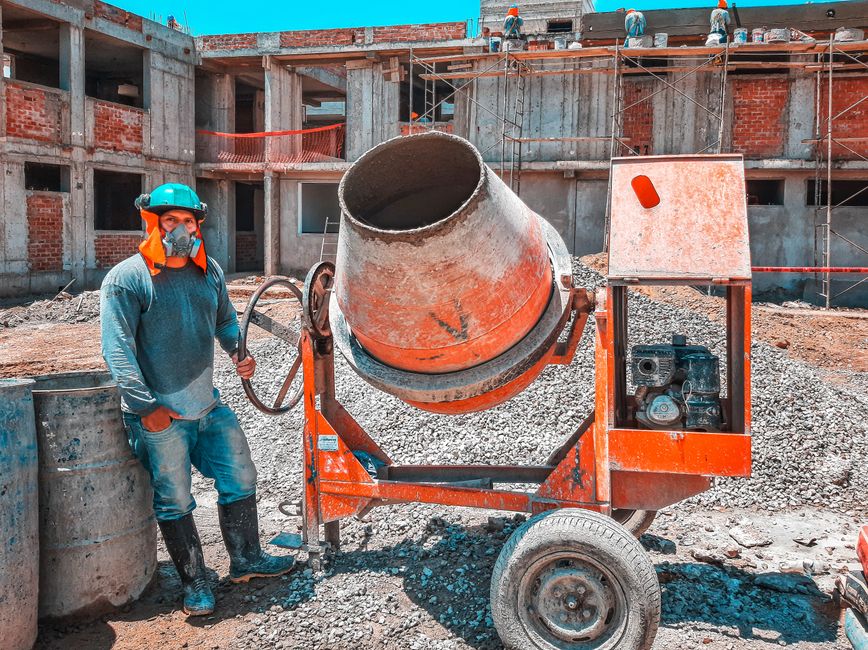
The RPE problem is separate and worth naming clearly. Standard dust masks fail with silica because they are not rated for respirable crystalline silica. An FFP1 mask, the kind you see on half the faces on any busy Irish site, offers inadequate protection. The minimum for silica work is FFP3, and only when it is fit-tested, correctly worn, and used alongside engineering controls. A loose-fitting FFP3 pulled over a beard is not protection. It is paperwork.
Health surveillance is the part most employers have not started. Where workers are regularly exposed to silica above the occupational exposure limit of 0.1 mg per cubic metre, lung function testing and periodic medical review are required. Spirometry tells you whether lung capacity is declining. Catching that early does not reverse the damage but it changes what happens next: the worker gets removed from exposure before the disease progresses to the point of serious disability. On the majority of smaller sites, health surveillance for silica does not exist. Some employers had never heard it was required.
What Catching Up Actually Looks Like
Employers who are genuinely scrambling to close the gap after the campaign need to move through a specific sequence. First, identify every task on site that disturbs silica-bearing materials: concrete cutting, block work, mortar removal, core drilling, scabbling, and any work with stone. Second, run a written risk assessment that names the controls in the correct hierarchy. Third, source on-tool suppression equipment for cutting tasks and specify it in the method statement. Fourth, sort out RPE: get FFP3 masks, get them fit-tested, and train workers on donning and doffing. Fifth, set up health surveillance with an occupational health provider before workers accumulate enough exposure to matter.
None of this is administratively complex. The complexity is cultural. A site where the attitude is "it's only dust" does not fix itself because a campaign ran. It fixes itself when a supervisor walks past a dry cut and stops it, when workers understand what they are protecting themselves from, and when the safety file shows evidence of real controls rather than a box-ticked risk assessment that nobody reads.
The Regulation Works, the Implementation Does Not
The framework is sound. The Chemical Agents Regulations, the Safety, Health and Welfare at Work Act, and the accompanying HSA guidance give employers everything they need to run a compliant operation. The problem is not regulatory gaps. It is the distance between a regulation on paper and a foreman on a wet Tuesday in Kildare who needs to get a wall knocked out by noon. That distance is where silicosis lives.
The all-island campaign matters because it names the thing publicly and puts inspectors on sites looking specifically for it. Workers who had never heard the word silica heard it from an HSA inspector. That is not how awareness should travel, but at this point, it is better than it not travelling at all.
The dust is there whether you can see it or not. The disease takes 10 to 20 years to surface, which is exactly why it keeps getting ignored. By the time a worker gets the diagnosis, the foreman who skipped the water suppression has long since moved on to another site.