An app on your phone cannot squeeze your brake lever and feel how much travel is left before it hits the bar. That gap between what technology measures and what a mechanic notices is where brake failures happen.
Cycling UK's guide to smartphone apps for cyclists covers a wide range of tools, from route planners to fitness trackers to basic maintenance reminders. The guide is useful. The problem is how riders are using it. Many are treating a maintenance log app as a substitute for having someone who actually knows bikes look at the thing. They record their mileage, tick off their chain lube dates, and roll out onto the N11 or the Naas Road convinced the bike is roadworthy. It may not be.
The core issue is not the apps themselves. It is the gap between data and inspection. An app can tell you how many kilometres you have covered since your last service. It cannot tell you that your rear brake cable has started to fray inside the housing where you cannot see it, or that your front tyre has a small sidewall bulge that is three hard corners away from a blowout. That requires hands and eyes on the bike.
What Maintenance Apps Actually Track
Most dedicated bike maintenance apps, Bike Doctor, Velo Maintenance, and similar tools, work on mileage intervals. You log a ride, the app calculates wear, and it flags when components are due for attention based on manufacturer guidelines.
This is genuinely useful for things like chain replacement. Chains wear in a measurable, predictable way. A chain wear indicator tool and a mileage log together give you a reasonable picture. Cassette wear, cable replacement intervals, brake pad thickness on certain caliper types: these also follow patterns that interval tracking can flag reasonably well.
Where the system breaks down is with failure modes that do not follow a schedule. A tyre can be two weeks old and have a piece of glass embedded that is slowly working toward the tube. A hydraulic brake can lose pressure from a seal that failed not from age but from a small knock the rider did not notice. A quick release skewer can be loose because someone else picked up the bike and put it back down carelessly.
None of these will show up in any app. Ever.
The Irish Road Context Makes This Worse
Irish cycling infrastructure is improving, but the roads themselves are unforgiving. Potholes, sudden drain covers, broken tarmac on rural routes: these create stresses on components that laboratory wear curves do not account for. A rider commuting through Dublin city centre or along any rural road west of the Shannon is putting far more dynamic load through their wheels and tyres than a rider covering the same distance on smooth tarmac.
This matters for cyclist and pedestrian safety on Irish roads more broadly. When a brake fails on a bike doing 30km/h in traffic, the cyclist is not the only person at risk. The pedestrian stepping off the kerb is in the picture too.
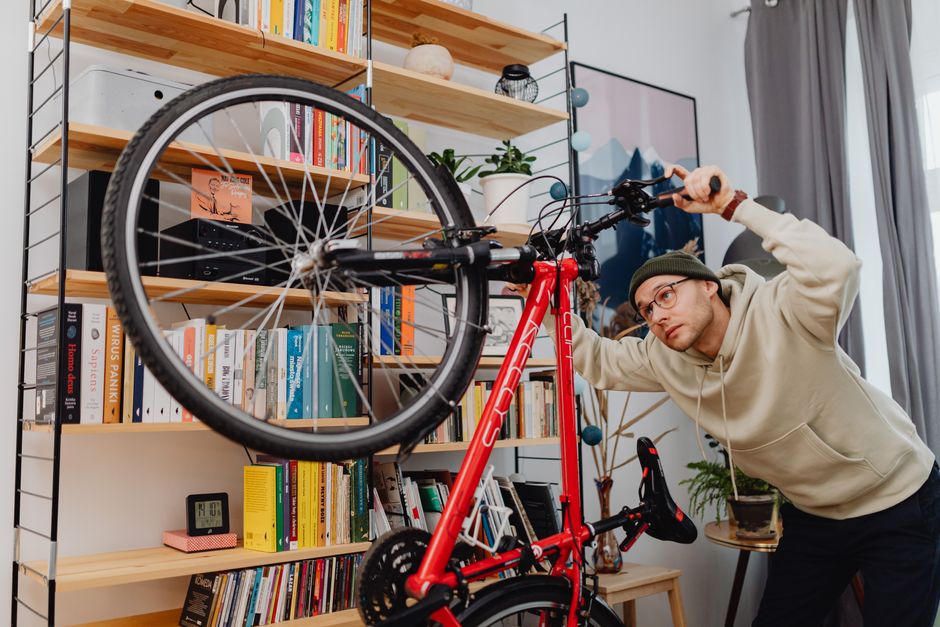
A professional service, done twice a year at minimum for a regular commuter, involves a mechanic going over the entire bike systematically. They flex the wheels, check spoke tension, squeeze every brake lever through its full range, inspect tyres by feel as well as sight, and test shifting under load. A good independent bike shop will catch problems the rider has completely normalised, like a gradual increase in brake lever travel they have adjusted to without realising.
Why Riders Are Skipping This
Cost is part of it. A full service at a reputable Irish bike shop runs from around €60 to €120 depending on the work needed. For someone who bought a €400 commuter bike, that feels like a significant proportion of the bike's value.
Convenience is part of it too. Booking a bike in, leaving it for a few days, getting back without your main transport: that is friction. An app on your phone has zero friction. You open it, log a ride, feel organised, and move on with your day.
There is also a confidence problem. Maintenance apps are often designed to feel reassuring. Green ticks, percentage bars, "components in good condition" notifications. This is good UX and genuinely dangerous safety culture. A screen telling you everything is fine is not the same as everything being fine.
What Professional Servicing Finds That Apps Cannot
A mechanic carrying out a proper inspection will check for:
Brake pad wear and alignment. Not just thickness, but whether the pad is hitting the rim or rotor squarely, whether the caliper is centred, and whether rim brakes have worn a groove into the braking surface of the wheel itself. A worn aluminium rim can fail catastrophically under hard braking.
Cable and housing condition. Outer cable housing cracks. Inner cables fray, especially at anchor points. Both degrade braking and shifting performance gradually enough that the rider does not notice.
Bearing condition. Headset, bottom bracket, wheel hubs. Worn bearings create play in the steering and drivetrain. Play in the headset specifically affects handling at speed in ways that become critical when you need to make a sudden evasive move.
Tyre condition beyond the obvious. Sidewall cracking from UV exposure, cuts that have penetrated the carcass, uneven wear that suggests alignment or inflation issues.
Frame and fork integrity. Carbon frames especially need a physical inspection for invisible cracks around stress points. No app will find this.
The Reasonable Middle Ground
Apps are good tools when used correctly. Use them to track chain wear, set reminders for lubrication, and log your service history. They create a maintenance record that is genuinely useful when you bring the bike in. A mechanic who can see that you covered 3,000km since the last cable change has better information to work with.
The mistake is treating the app as the endpoint rather than the input. The endpoint is the physical inspection by someone who knows what they are looking at.
For regular commuters, a professional service twice a year is the floor. If you are covering more than 150km a week, quarterly is more appropriate. After any significant impact, pothole strike, or crash, the bike needs to be looked at before it goes back on the road, regardless of what the app says.
The apps did not create complacency about bike maintenance. That existed long before smartphones. What they did is give the complacency a tidy interface and a green tick.
Your brakes do not care how organised your app looks.