You cannot see the dust that gives you silicosis. That is the whole problem.
It settles on your lungs over years, not hours. By the time a worker coughs enough to see a doctor, the scarring is already done. There is no treatment that reverses silicosis. There is no surgery that gives you your lung function back. What you lose, you lose for good.
What the All-Island Campaign Is Actually Saying
The Health and Safety Authority in Ireland and the Health and Safety Executive in Northern Ireland have been running a joint silica awareness campaign targeting construction and related trades. The message is straightforward: respirable crystalline silica (RCS) kills workers, the exposures are happening on sites right now, and most crews are not adequately protected.
The occupational exposure limit for RCS in Ireland is 0.1 mg/m³ as an eight-hour time-weighted average. Cut one concrete block dry with an angle grinder and you can hit concentrations more than 20 times that figure within seconds. The limit is not a safe level. It is the maximum permissible level above which the law says you are clearly negligent. There is a difference, and it matters.
What the campaign is pushing is not a new regulation. The legal duties already exist under the Safety, Health and Welfare at Work (Chemical Agents) Regulations. The campaign is trying to close the gap between what the law requires and what actually happens on Monday morning when someone needs a block cut quickly.
Why Crews Underestimate It
Silica dust looks like ordinary dust. Sometimes it looks like nothing at all. Respirable particles, the ones that reach deep into lung tissue, are invisible to the naked eye. Workers who have cut stone and concrete for 20 years without obvious symptoms believe they are fine. Some of them are. Some of them are not, and will not know for another decade.
The latency period is the killer. Silicosis can take 10 to 30 years to show up clinically. A site manager who is 35 today and cutting dry with no controls is banking on a health debt that comes due when he is 55 and his kids are in college. The industry's cultural tendency to dismiss dust as ordinary messiness compounds this. Nobody treats dust the way they treat a live electrical cable, even though the long-term mortality data is comparable.
There is also a specific and urgent problem with engineered stone. Worktops made from compressed quartz can contain up to 93% crystalline silica, compared to around 30% in natural granite. Workers cutting, grinding, or polishing engineered stone without water suppression and respiratory protection are at acute risk. Cases of accelerated silicosis in young workers, some in their 30s, have emerged across Australia, the UK, and Spain. The same materials are on Irish kitchen worktops right now.
The Hierarchy Works. Ignoring It Does Not.
Respiratory protection gets talked about most because it is visible. But it sits at the bottom of the control hierarchy for a reason. It is the last line of defence, not the first.
Elimination and substitution come first. If you can avoid cutting silica-containing materials on site, do it. Pre-cut off-site in a controlled environment. Use lower-silica alternatives where specification allows. This is not always possible, but it is always the first question to ask.
Engineering controls come second. On-tool water suppression reduces airborne dust at source. Local exhaust ventilation (LEV) captures dust before it reaches breathing zones. These are not optional extras for big sites with big budgets. They are legal requirements when elimination is not possible. An H-class vacuum attached to an angle grinder costs less than a week's worth of disposable FFP3 masks for a full crew. It also works better.
Wet cutting with adequate water flow reduces RCS exposure by over 85% compared to dry cutting. That figure comes from HSE measurement data. A trickle of water that turns to steam on a hot blade is not wet cutting. The flow rate needs to be sufficient to keep the cutting zone genuinely saturated.
Work organisation matters too. Rotate workers to limit individual exposure time. Do not position workers downwind of cutting operations. Schedule high-dust tasks when the fewest people are present in the area.
When You Do Need Respiratory Protection
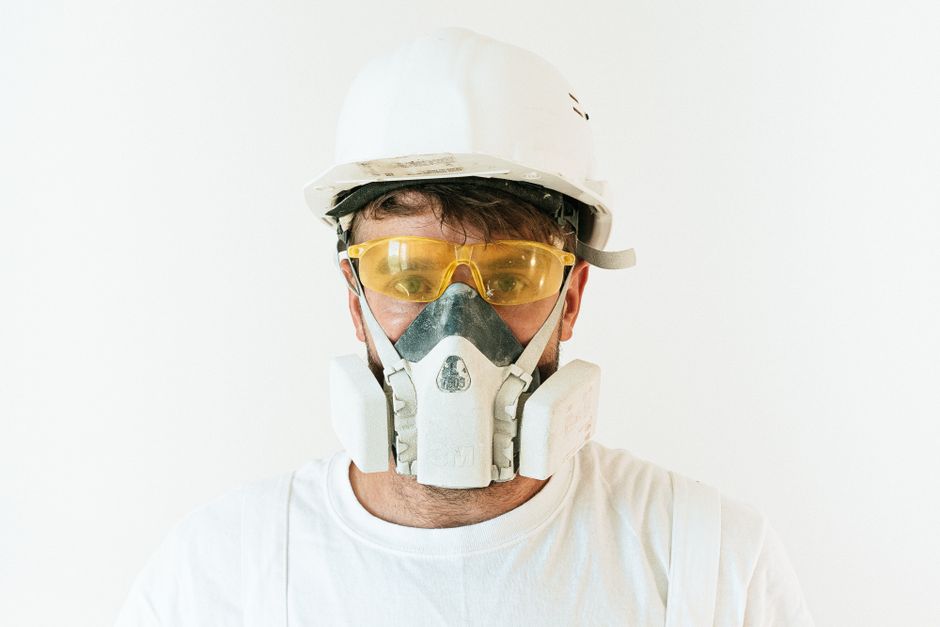
After engineering controls are in place and working, you still often need RPE. The standard for silica work is FFP3. Not FFP2. Not a dust mask from a DIY shop. FFP3.
FFP3 disposable masks filter at least 99% of airborne particles when fitted correctly. The key phrase is "fitted correctly." A mask worn with a beard, under the chin, or with gaps at the cheeks provides negligible protection. Fit testing is not a bureaucratic nicety. It is the only way to confirm that a specific mask model seals on a specific person's face.
Fit testing costs roughly €20 to €40 per worker and takes about 20 minutes. It is required under Irish law for tight-fitting respirators. Many sites either skip it or do it once and never repeat it. Workers who gain or lose significant weight, or who have dental work done, should be retested.
Powered air-purifying respirators (PAPRs) are more comfortable for prolonged work and remove the seal dependency of disposable masks, making them viable for workers who cannot achieve an adequate fit with disposable FFP3 units.
Medical Surveillance Is Not Optional
Under the Chemical Agents Regulations, workers with significant silica exposure are entitled to health surveillance. In practice this means lung function testing, at minimum spirometry, at regular intervals. The purpose is not to catch silicosis once it is advanced. The purpose is to detect declining lung function early enough to act, by removing the worker from exposure before the damage becomes irreversible.
Many small and medium contractors simply do not have health surveillance programmes in place. The HSA knows this. It is an inspection priority. A contractor without records of health surveillance for workers regularly exposed to RCS is not in compliance, and inspectors are not in a forgiving mood on this point.
The Turn
An all-island campaign will not change site behaviour on its own. Campaigns raise awareness. What changes behaviour is consistent enforcement, management commitment, and a site culture where cutting dry without controls is as socially unacceptable as not wearing a hard hat. That culture shift has happened with falls from height. It has happened, slowly, with noise. It needs to happen with dust, and it needs to happen faster than the disease progression allows.
The toolbox talk that explains silicosis, the foreman who stops dry cutting immediately and without drama, and the company that funds fit testing without being asked are all doing more than any poster campaign. Start there.