You cannot see the dust that causes silicosis. That is not a metaphor. Respirable crystalline silica particles sit at 10 microns or smaller, invisible to the naked eye, and they are floating through your site right now if anyone is cutting, grinding, or drilling into concrete, brick, or sandstone.
The all-island silica campaign, running jointly between the Health and Safety Authority in the Republic and the Health and Safety Executive Northern Ireland, has moved this from a background concern to active enforcement. Inspectors are visiting construction sites specifically looking for silica controls. Not suggesting them. Looking for them. The difference matters.
Silicosis is irreversible. Lung tissue scarred by silica does not heal. Workers exposed over years develop a progressive, untreatable condition that ends with them unable to walk across a room without stopping for breath. Lung cancer and chronic obstructive pulmonary disease follow. There is no medical intervention that undoes it. This makes prevention the only strategy worth having.
Where Silica Actually Lives on Your Site
Silica is not exotic. It is in the materials you use every day. Concrete is 25 to 50 percent silica by composition. Sandstone runs as high as 90 percent. Brick, mortar, tiles, and fibre cement boards all contain it. The hazard does not come from handling these materials. It comes from breaking them.
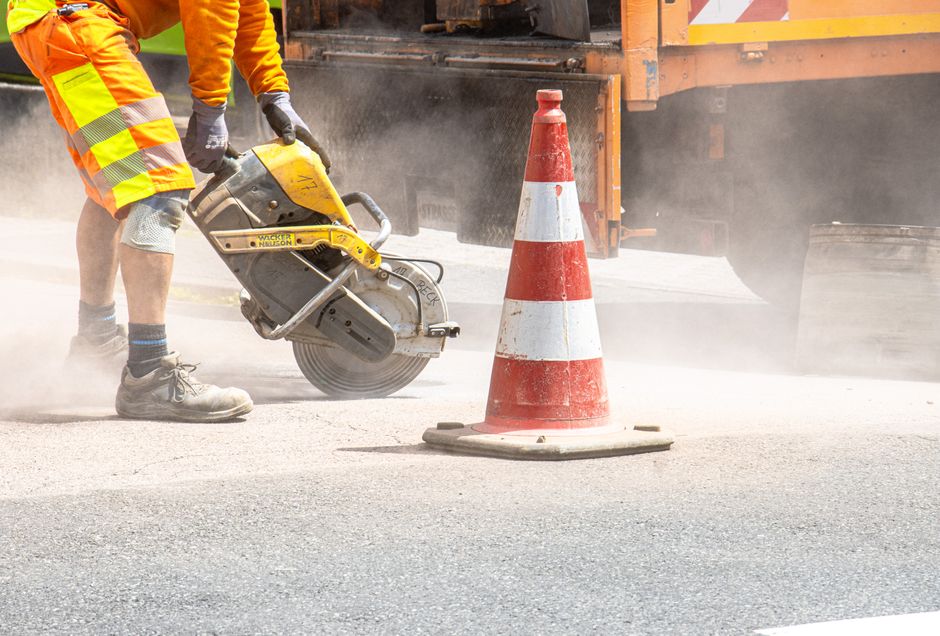
Angle grinding concrete creates the worst exposure. Dry cutting kerbs and flags with a disc cutter is close behind. Scabbling and jackhammering generate sustained clouds at concentrations that can exceed the occupational exposure limit within seconds. Core drilling without water suppression, chasing walls for cables, and demolishing block walls by hand all produce significant silica exposure. Anyone within the dust cloud is being exposed. That includes workers two trades down the line who never touched the tool.
The occupational exposure limit for respirable crystalline silica in Ireland is 0.1 mg/m3 as an eight-hour time-weighted average. That number sounds clinical until you understand that hand-held angle grinding on concrete without any controls can generate concentrations more than 100 times that limit. The regulation sets the floor. Physics determines the actual exposure.
How to Measure What You Cannot See
You cannot manage a hazard you have not quantified. Dust monitoring is the step most sites skip entirely, and it is the step the HSA is most interested in during inspections.
Personal air sampling is the standard method. A worker wears a pump and cassette on their lapel for a full shift, the sample goes to an accredited laboratory, and the result tells you the actual concentration they inhaled during those hours. This is not a daily task for every worker. It is a periodic assessment tied to specific tasks and tools, reviewed when those tasks or tools change. The Chemical Agents Code of Practice sets out the framework. Your safety statement should specify when sampling is done and who reviews the results.
Indicative monitoring with direct-reading instruments gives real-time information during task assessment. These tools do not replace laboratory sampling, but they are useful for comparing controls, checking that water suppression is actually reducing exposure, and identifying tasks that need immediate attention before formal sampling is complete.
A risk assessment that says "dusty work, controls in place" is not a dust assessment. It is a placeholder. Name the tasks, name the tools, name the materials, and attach monitoring data.
The Hierarchy That Actually Works
Elimination first. If you can design out the cutting task, do it. Specifying precut materials, using mechanical fixings instead of chased conduit, ordering blocks in the right dimensions rather than cutting to fit. These are design decisions made before anyone picks up a grinder.
Where cutting is unavoidable, wet methods are the single most effective control. Water suppression on angle grinders, disc cutters, and core drills reduces airborne silica by over 90 percent when applied correctly. Correctly means a continuous water flow at the blade, not a worker occasionally sloshing a bottle near the work. Purpose-built attachments that deliver water to the cutting point are available for every standard site tool.
On-tool extraction is the second major control, used where wet methods are impractical, such as indoor chasing or wall grinding where water would cause damage. A vacuum extraction unit fitted with an H-class filter and a shroud attached to the tool captures dust before it becomes airborne. The extraction unit rating matters. M-class filters are not adequate for silica. H-class only.
Enclosures and local exhaust ventilation work for fixed processes, block saws with integrated extraction, tile saws with wet cutting, and similar setups. These are engineering controls and they sit above respiratory protective equipment in the hierarchy for good reason.
Respiratory Protective Equipment: Last Resort, Not First Line
Respiratory protective equipment is the last line of defence. It is not a substitute for engineering controls. The engineered stone ban brought this into sharp focus for countertop fabrication, but the principle applies across all silica work on site.
For residual exposure after engineering controls, a minimum of FFP3 disposable filtering facepiece is required. FFP2 does not provide adequate protection for silica. FFP3 provides an assigned protection factor of 20 against the workplace exposure limit, which means it reduces exposure by a factor of 20, assuming correct fit and use.
Correct fit is not assumed. It is tested. Face fit testing is mandatory before a worker uses tight-fitting respiratory protective equipment. A mask that does not seal against the face leaks at every breath. Beards break the seal. Cold weather causes workers to pull the mask away from their face. RPE programmes that consist of handing out disposable masks at the gate and calling it done are not programmes. They are theatre.
Health Surveillance: The Legal Requirement Nobody Mentions
If workers are regularly exposed to silica above the action level, you are legally required to provide health surveillance. Under the Chemical Agents Regulations, that means a baseline assessment before exposure begins and periodic reviews thereafter. In practice this means lung function testing and a health questionnaire, reviewed by an occupational physician.
Health surveillance does not prevent silicosis. It detects early changes before they become catastrophic, allows reassignment before further damage occurs, and creates a medico-legal record that protects both the worker and the employer. Skipping it is not just a regulatory breach. It is the difference between catching a problem at stage one and discovering it at stage four.
Records must be kept for 40 years. That is not a typo.
What the Campaign Means in Practice
The all-island campaign is not an awareness initiative. It has enforcement teeth. Inspectors arriving on site will look for documented risk assessments naming silica tasks, evidence of monitoring, records of RPE face fit testing, health surveillance registers, and functioning wet suppression or extraction on tools in use. A verbal explanation of what you intend to do is not evidence.
The construction sector generates a disproportionate share of occupational lung disease cases in Ireland. That statistic exists because silica work has been treated as an acceptable background condition of the job for decades. The campaign is the regulatory system saying that it is no longer acceptable, and that the evidence of control needs to exist in writing before the inspector walks through the gate.
Get the monitoring done, get the engineering controls fitted, test the masks, start the health surveillance. The dust was always there. Now so are the consequences of ignoring it.