Silica dust kills slowly, quietly, and without a second chance. By the time a worker gets the diagnosis, the damage is already done and the lung tissue that's gone is gone for good.
The HSA has been running campaigns. The posters are up. The toolbox talks have been delivered. And yet silica-related lung disease is still ending careers and cutting lives short on Irish construction sites. The gap is not awareness. The gap is understanding. Workers know dust is bad. They do not know whether what they are doing about it is actually working.
What You're Up Against
Respirable crystalline silica, RCS, is the fraction of silica dust small enough to pass through your nose and throat and lodge deep in your lungs. You cannot see it. Standard dust you can see in a shaft of light is largely too coarse to cause the real damage. The particles doing the harm are invisible to the naked eye.
Concrete cutting, block grinding, disc cutting on kerbs, jackhammering through sandstone, scabbling floors. These are the activities generating RCS in dangerous concentrations. A dry cut through a concrete block with an angle grinder can push airborne silica to 40 or 50 times the workplace exposure limit within seconds. The exposure limit in Ireland is 0.1 milligrams per cubic metre of air, averaged over an eight-hour shift. A few minutes of dry cutting without controls can blow through a week's worth of permissible exposure in one go.
Silicosis in 2026 is not a relic of Victorian industry. Cases are appearing in workers in their thirties and forties. Accelerated silicosis, which develops within five years of heavy exposure, is now documented in young tradespeople who worked with engineered stone worktops. The disease does not announce itself early. A slight shortness of breath. A cough that gets written off. By the time a scan shows the scarring, you are managing a condition, not curing one.
The Hierarchy That Most Sites Ignore
The law requires a hierarchy of controls. Respiratory protective equipment, the mask, sits at the bottom. It is the last line of defence when engineering and administrative controls have already failed or are genuinely impractical. Most sites treat it as the first and only line.
Engineering controls come first. Wet suppression kills RCS at source by binding particles before they become airborne. An angle grinder or disc cutter fitted with a water attachment cuts the dust generation dramatically. On-tool extraction, a shroud connected to an industrial vacuum with a HEPA-rated filter, captures dust at the point of production before it disperses into the breathing zone. Neither is complicated. Both require the right equipment and a foreman who enforces their use.
Administrative controls layer on top. Limit the time any one worker spends on high-dust tasks. Rotate jobs. Schedule dusty work when fewer workers are nearby. Create exclusion zones around cutting areas. These reduce cumulative exposure across the shift.
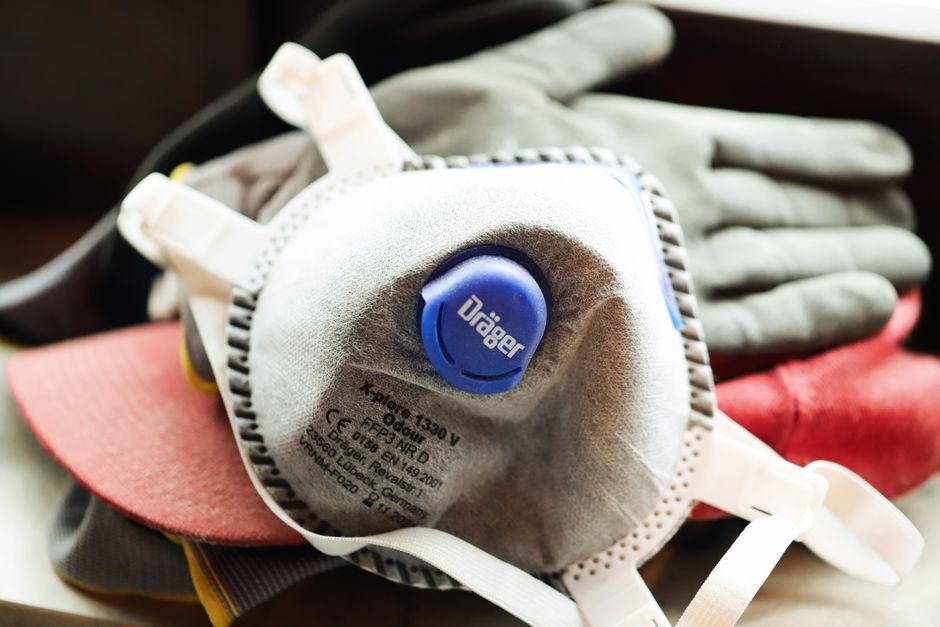
RPE, the mask, handles what gets past everything else. A disposable FFP3 mask is not equivalent to a full-face powered air-purifying respirator. An FFP2 is not adequate for silica cutting work. The assigned protection factor for an FFP3 is 20. For a powered hood respirator it is 40. Those numbers matter when airborne concentrations can reach 50 times the limit.
What Passes for Dust Control on Most Sites
A lad doing a dry cut with an angle grinder, wearing an FFP1 mask he pulled from an open bag in the site cabin, breathing in whatever the wind doesn't carry away. That is not dust control. That is theatre.
The common shortcuts that provide no meaningful protection:
Dry cutting without extraction. Cutting dry doubles to quadruples the airborne concentration compared to wet methods. The speed saving does not exist once you factor in cleanup, health costs, and enforcement risk.
Wrong mask grade. FFP1 masks filter 80% of airborne particles. FFP3 filters 99%. For silica work, FFP1 is effectively useless. FFP2 is marginal at best. The grade has to match the hazard.
Mask fit. A disposable FFP3 worn without a face fit test can leak 50% or more of contaminated air around the seal. Stubble breaks the seal. Glasses frames break the seal. A mask with a failed fit is delivering a fraction of its rated protection. Face fit testing is not optional under the Safety, Health and Welfare at Work (Chemical Agents) Regulations. It is required.
Leaving masks lying around. A contaminated FFP3 left on a dusty surface and reused the next day is not a clean respirator. Disposable masks are single-use for a reason.
What a Compliant Approach Actually Looks Like
Start with the activity. Before anyone picks up a disc cutter, the plan should specify wet or extraction. If wet suppression is in use, the water supply needs to be connected and flowing before the blade touches the material, not added as an afterthought.
On-tool extraction units need to be H-class or M-class rated, not domestic hoovers with a fine filter. H-class filters handle RCS. Domestic units do not. The filter needs regular inspection and replacement.
Workers using RPE need face fit tests documented in writing, refreshed when they change mask model or their face shape changes significantly. The tests need to be done by a competent person, not guessed at on site.
Health surveillance is a legal requirement for workers with regular silica exposure. Annual lung function testing through spirometry, baseline measurements when a worker starts, records maintained and available. This is not box-ticking. It is the mechanism that catches early-stage disease before it becomes irreversible.
The Engineered Stone Problem Is Not History
The ban on engineered stone in worktop fabrication addresses the highest-risk single exposure source identified in recent years. But the ban covers fabrication. Fitting, cutting to size on site, drilling for sinks and taps. This still happens in kitchens across the country, often by small contractors with no extraction equipment and no fit-tested masks.
The material contains up to 90% crystalline silica. One dry cut releases an exposure load that would take a concrete worker hours to accumulate.
The Turn
The HSA campaigns are doing their job. Awareness is genuinely higher than it was five years ago. What has not kept pace is practical competence. Site managers who know silica is dangerous but cannot tell an H-class vacuum from a standard construction hoover are not equipped to enforce controls. Workers who know they should wear a mask but grab whatever is nearest are not protected.
Knowing the hazard exists is the beginning. Knowing whether the control you are using actually works is what keeps lungs intact.